Table of Contents
- What a Federal Pacific Panel Is and Why It’s Still in Homes
- The Safety Concern: Breakers That Fail to Trip
- What the CPSC Investigation Found (and What It Didn’t)
- Federal Pacific Panel Warning Signs You Should Never Ignore
- What a Federal Pacific Panel Inspection Should Cover
- Federal Pacific Panel Replacement: When and How
- Federal Pacific Panel Home Sale and Insurance Issues
- Conclusion
- Frequently Asked Questions
Last Updated: October 18, 2026
What a Federal Pacific Panel Is and Why It’s Still in Homes
At CNE Electrical, we get asked about these panels constantly during North Shore home assessments. Homeowners want a straight answer, not a sales pitch.
Here it is: the concern is real, the evidence is mixed, and the right move depends on what an inspection finds.
Federal Pacific Electric sold millions of these panels during a national building boom, and they ended up in ranches, capes, and split-levels all over Massachusetts.
That longevity is the problem.
The Safety Concern: Breakers That Fail to Trip
The core worry with Stab-Lok breakers is failure to trip. A breaker’s only job is to open the circuit when current exceeds safe limits.
That heat has nowhere to go. It builds inside the panel, inside the walls, inside the outlet box.
The failure mode has two versions:
- Overload: a circuit draws more current than it should, and the breaker should trip but doesn’t
- Short circuit: a hot wire contacts neutral or ground, and the breaker should trip instantly but doesn’t
Both scenarios leave overcurrent protection effectively absent.
There’s also a mechanical angle.
What most guides miss is that this isn’t a guaranteed failure. Plenty of Stab-Lok breakers have tripped correctly for decades.
Never test a breaker by deliberately creating a short circuit or overload. This can cause arcing, fire, or shock. Breaker testing requires specialized equipment and a licensed electrician.
What the CPSC Investigation Found (and What It Didn’t)
The Consumer Product Safety Commission looked into Federal Pacific Stab-Lok breakers in the early 1980s, and that investigation is the source of nearly every claim you’ll read online. Most misstate what the record actually says.
Here is what the public record supports:
- The CPSC opened an investigation into Stab-Lok circuit breakers and their failure to trip under overload and short-circuit conditions.
- Testing during that era was conducted under contract, and some results raised questions about whether certain breakers met their calibration and trip requirements under the applicable UL standard for molded-case circuit breakers (UL 489).
- The commission closed the investigation without issuing a recall and without issuing a formal finding that the panels were defective.
What the record does not support matters just as much. There is no federal recall of Federal Pacific Stab-Lok panels, no federal ban, no official declaration that every panel bearing the name is dangerous, and no official finding that they are fine (Commission Closes Investigation Of FPE Circuit Breakers And Provides Safety Information…).
Reconciling the failure-rate claims you’ll see online
You will encounter specific failure percentages attributed to Stab-Lok breakers, often in the range of a substantial minority of units tested failing to trip. Treat any single number with caution: those figures typically trace back to limited test samples, to conditions that don’t map cleanly onto a panel in a 1970s ranch house, or to secondary sources repeating a figure without context. The honest reading is narrower:
- The testing raised legitimate questions about trip reliability in some units.
- It did not establish a failure rate that applies to your specific panel.
- It did not establish that a Stab-Lok breaker in your basement will fail, only that the margin of confidence is lower than it should be for a life-safety device.
That distinction drives the right decision. You are not deciding whether “all FPE panels are deadly”, you are deciding whether an overcurrent device with a documented question mark and five decades of untested service is worth the risk in your home.
There is no recall and no ban, but there is also no clean bill of health. The evidence supports elevated concern about breaker trip reliability, not certainty of failure, and not proof of safety.
We tell homeowners to think of it like a smoke detector with an unknown battery. It might work. You just don’t know, and the cost of being wrong is high.
Federal Pacific Panel Warning Signs You Should Never Ignore
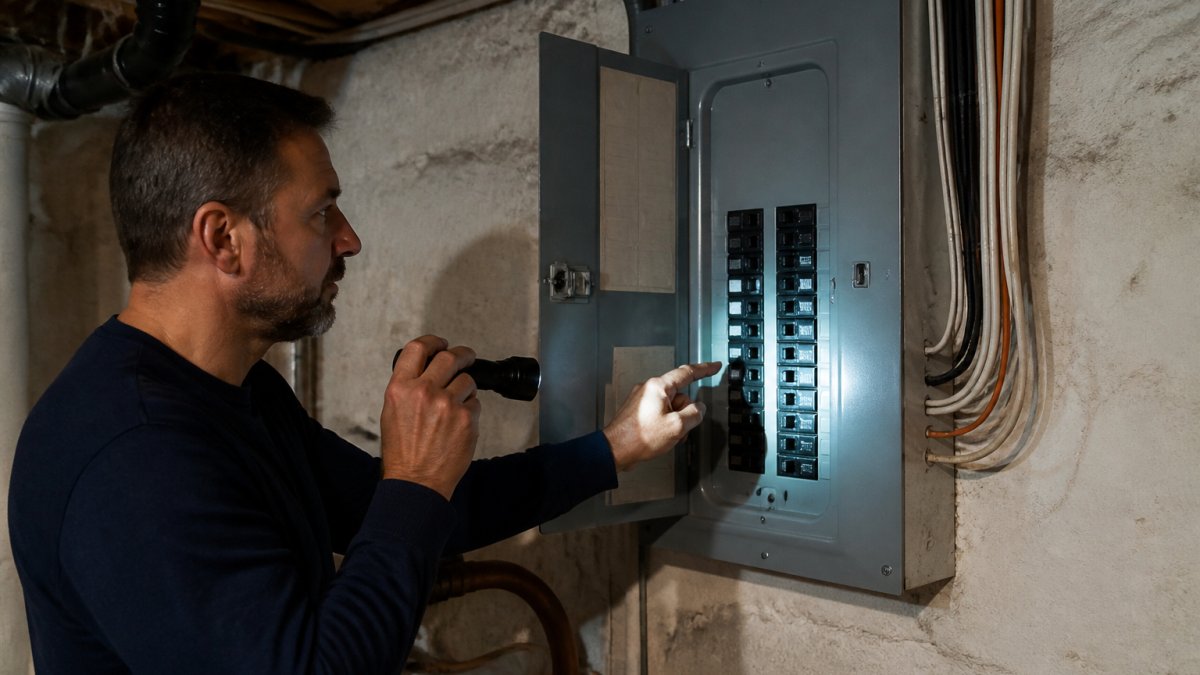
Some symptoms mean call an electrician today, not next month. Watch for these Federal Pacific panel warning signs:
- Burning smell near the panel, with no obvious source
- Discolored or scorched breakers, or brown heat marks on the panel cover
- Breakers that feel warm to the touch during normal use
- A breaker that trips repeatedly and won’t stay reset
Any one of these warrants immediate attention. A burning smell or visible scorching means shut off power at the main and call a licensed electrician right away.
The core problem with Federal Pacific Stab-Lok breakers is not cosmetic. Independent testing has found that some Stab-Lok breakers fail to trip properly during overload conditions, meaning a circuit can stay energized during a fault it is supposed to interrupt. The Consumer Product Safety Commission investigated these breakers and closed its inquiry in 1983 without issuing a recall and without determining the breakers were safe. The panels were never federally recalled, and no agency has cleared them as safe: the investigation was simply closed.
The most dangerous sign is the absence of signs. A Federal Pacific panel can fail silently, so visible symptoms are a bonus warning, not a reliable test.
What a Federal Pacific Panel Inspection Should Cover
Before anyone opens a panel, you can gather useful information safely from the outside.
Safe identification checklist (no tools, no cover removal)
You can confirm a suspected panel without touching energized parts. Work only with the panel cover on and the power on, and never remove a deadfront yourself.
- Read the panel label. Look on the inside of the door or on the panel face for the manufacturer name. Federal Pacific Electric panels are often labeled “Federal Pacific,” “FPE,” or “Federal Pacific Electric,” and the Stab-Lok name frequently appears on the breakers or the label.
- Check the breaker faces. Stab-Lok breakers are typically marked “Stab-Lok” on the breaker itself. Note the breaker style and whether the panel uses the thin, stab-mounted breakers characteristic of the line.
- Look for the model or catalog number on the label or door. Write it down; it helps an electrician confirm the panel family before a visit.
- Note the service size if it’s printed on the label (common ratings are 100A, 125A, 150A, and 200A).
Confirming the panel is only the first step. If this checklist points to a Federal Pacific Stab-Lok panel, replacement is worth discussing with a licensed electrician even when the panel shows no signs of trouble. A visual check from outside the panel cannot confirm how the breakers will perform during an actual overload, so identifying the panel does not clear it, and a routine inspection alone does not resolve the underlying concern.
Never remove a panel cover, touch a breaker you suspect is damaged, or probe inside a panel. The bus and lugs remain energized with the main breaker on, and a compromised Stab-Lok connection is exactly the kind of fault you don’t want to disturb.
What a qualified inspection actually covers
Once an electrician is on site, a proper Federal Pacific panel inspection goes well beyond taking the cover off:
- Confirm the panel brand and model from the label and breaker markings
- Remove the deadfront and inspect bus bars for pitting, corrosion, or heat damage
- Check breaker-to-bus connections for looseness and arcing marks
- Look for double-tapped breakers and undersized or oversized breakers
Notice what’s not on that list: guessing. A thorough inspection can catch physical damage, loose connections, and corrosion, but it cannot confirm whether a breaker will trip properly under an overload. Some Federal Pacific breakers have documented problems with failing to trip when they should, and that risk does not always show up as visible damage. A panel that looks clean on the outside is not the same as a panel confirmed to be safe.
Your step-by-step decision guide
If you suspect a Federal Pacific panel, here is the sequence that keeps you safe and gives you real information:
- Identify from the outside using the checklist above. Don’t remove covers.
- Gather your documents, panel label photos, the home inspection report if you have one, and any prior electrical permits or records.
- Watch for urgent signs. Burning odors, buzzing, visible scorching, a warm cover, or a breaker that won’t reset mean stop using the affected circuits if you can do so safely and call a licensed electrician promptly. If there is smoke or fire, leave the home and call 911.
- Schedule a licensed assessment. A home inspector identifies the brand; a licensed electrician assesses condition, trip performance where testable, and capacity.
- Ask for findings in writing, what was found, what it means, and whether replacement is recommended and why.
- Decide with your electrician. Heat damage, a failed trip test, or a capacity limit are clear signs that replacement is needed. Even without those signs, replacement is still worth discussing, since some Federal Pacific breakers have documented problems with failing to trip during an overload and a routine inspection cannot rule that risk out.
Ask the electrician to explain what they found and what it means. If they recommend replacement, they should point to something specific: heat damage, a failed trip test, a capacity limit, or the documented Federal Pacific trip-failure risk itself. If you’re weighing replacement against a service upgrade, an electrical service upgrade assessment can happen in the same visit.
Federal Pacific Panel Replacement: When and How
It’s not automatically required just because the label says Federal Pacific. The documented concern is more specific: some Federal Pacific Electric Stab-Lok breakers have a history of failing to trip properly during overload conditions, and that is the core issue worth raising with an electrician. The Consumer Product Safety Commission investigated the breakers and closed its inquiry in 1983 without issuing a recall or concluding they were safe, so there is no official clearance to point to either way. Replacement is often the practical choice to discuss with a licensed electrician, even when the panel shows no obvious signs of trouble.
The process itself follows a predictable sequence:
- Site assessment to confirm service size, load, and what the replacement needs to support
- Permit application with the local building department
- Utility coordination for a temporary or permanent disconnect
- Panel removal and replacement, typically a one-day job for a straightforward swap
- Inspection and sign-off by the local authority
- Power restoration and circuit-by-circuit verification
Cost depends on service size, whether the meter socket and service entrance need work, permit fees, and how much rewiring the existing circuits need.
If you’re also planning a standby generator or a Level 2 EV charger, the panel and capacity decisions should happen together. A Generac standby generator installation or an EV charger installation both depend on a service that can carry the added load.
For homes that do need more capacity, an electrical service upgrade is the natural companion to a panel replacement.
Ask whether the replacement panel has a documented breaker recall history and available replacement breakers. Some older panel brands create the same parts-availability problem decades later.
Federal Pacific Panel Home Sale and Insurance Issues
A Federal Pacific panel home sale is where this issue gets expensive fast.
Three things tend to happen:
- The buyer asks for replacement as a condition of sale
- The lender or insurer raises questions about the panel during underwriting
- The deal stalls while everyone waits for an electrician’s report
Insurance coverage is the bigger long-term issue. Some carriers will insure a home with a Federal Pacific panel.
If you’re selling, get ahead of it. An inspection report documenting the panel’s condition gives you something concrete to negotiate with.
If you’re buying, don’t let a general home inspection be the final word. A home inspector can identify the brand, but confirming breaker trip performance isn’t part of a standard visual inspection, so a documented Federal Pacific panel is worth discussing with a licensed electrician before closing, even if nothing else about it looks concerning.
Conclusion
The Federal Pacific question has no clean yes or no, and anyone who gives you one is oversimplifying. Some FPE Stab-Lok breakers have documented problems with failing to trip during an overload, the CPSC closed its investigation in 1983 without issuing a recall, and a visual inspection alone cannot confirm a panel is safe. For a home with one of these panels, replacement is worth discussing with a licensed electrician even if nothing looks wrong.
If your home has one of these panels, a site assessment is the right next step to discuss your options, including replacement, not a decision made from a blog post. CNE Electrical is a licensed electrical contractor and Generac Authorized Dealer serving homeowners across the North Shore.
Frequently Asked Questions
Can you sell a house with a Federal Pacific panel?
You can sell a house with a Federal Pacific panel, but it will likely come up during the buyer’s home inspection. Many buyers and their agents treat an FPE Stab-Lok panel as a negotiation point, and some lenders or insurers may raise questions. A Federal Pacific panel home sale often goes smoother when the seller has a licensed electrician inspect the panel first and can document its condition or plan for replacement. Getting ahead of the issue usually helps avoid last-minute surprises at closing.
Are Federal Pacific electrical panels recalled?
No federal recall was issued for Federal Pacific Stab-Lok panels. The Consumer Product Safety Commission investigated the panels but closed its case in 1983 without issuing a recall or determining the breakers were safe, and the record is genuinely mixed. That does not mean the panels are considered safe today. Many electricians still flag Stab-Lok breakers because of documented problems with breakers failing to trip during an overload or short circuit. The lack of a recall is not the same as a clean bill of health, so an inspection by a licensed electrician and a conversation about replacement is the practical next step.
How can I tell if I have a Federal Pacific panel?
Look at the label inside the panel door. Federal Pacific Electric panels usually say ‘Federal Pacific’ or ‘FPE,’ and the breakers are often branded ‘Stab-Lok.’ The breakers themselves may have a thin, flat profile and a distinctive look. If the label is faded or missing, take a photo of the panel and breakers and have a licensed electrician confirm the brand during a Federal Pacific panel inspection. Do not remove the deadfront cover yourself, since the panel interior is live.
What should I do if my Federal Pacific panel is warm or making noise?
A warm panel, buzzing, crackling, or a burning smell are urgent warning signs. Stop using heavy appliances on affected circuits, do not touch the panel, and call a licensed electrician right away. If you see smoke, sparks, or scorching, leave the area and call 911. These symptoms can point to overheating or loose connections, and a Federal Pacific panel with these signs should be treated as a priority for inspection and likely replacement rather than something to monitor over time.