
Last Updated: November 1, 2026
Quick Summary
A standby home generator is permanently installed and starts automatically within seconds of an outage, then shuts down when utility power returns. Automatic transfer causes a brief interruption, not uninterrupted power, but it brings backup for essentials like heating, cooling, refrigeration and remote work, plus no extension cords, no manual start and stable power quality.
- An automatic transfer switch isolates your home from the grid and signals the generator to start.
- Sizing starts with a load calculation covering running watts, starting watts and fuel supply, not square footage.
- A fixed propane tank or natural gas connection supports multi-day outages better than portable fuel cans.
- Self-tests run the engine unloaded, so the unit can pass yet still fail under a real load.
- Maintenance, including oil and filter changes, battery, belt, coolant and a load test under actual demand, follows the manufacturer’s service schedule rather than a fixed yearly calendar.
Table of Contents
- What a Standby Home Generator Actually Does for You
- 8 Benefits of a Standby Home Generator, Numbered
- Whole-House Generator Pros and Cons: An Honest Look
- Standby Generator vs Portable Generator: Which Fits Your Home?
- Home Generator Maintenance: What Keeps It Ready to Run
- Standby Generator Lifespan and What Affects It
- Schedule a Standby Generator Site Assessment
- Frequently Asked Questions
What a Standby Home Generator Actually Does for You
A standby home generator is a permanently installed backup power system that monitors incoming utility voltage and starts automatically within seconds of an outage, then shuts down when utility power returns.
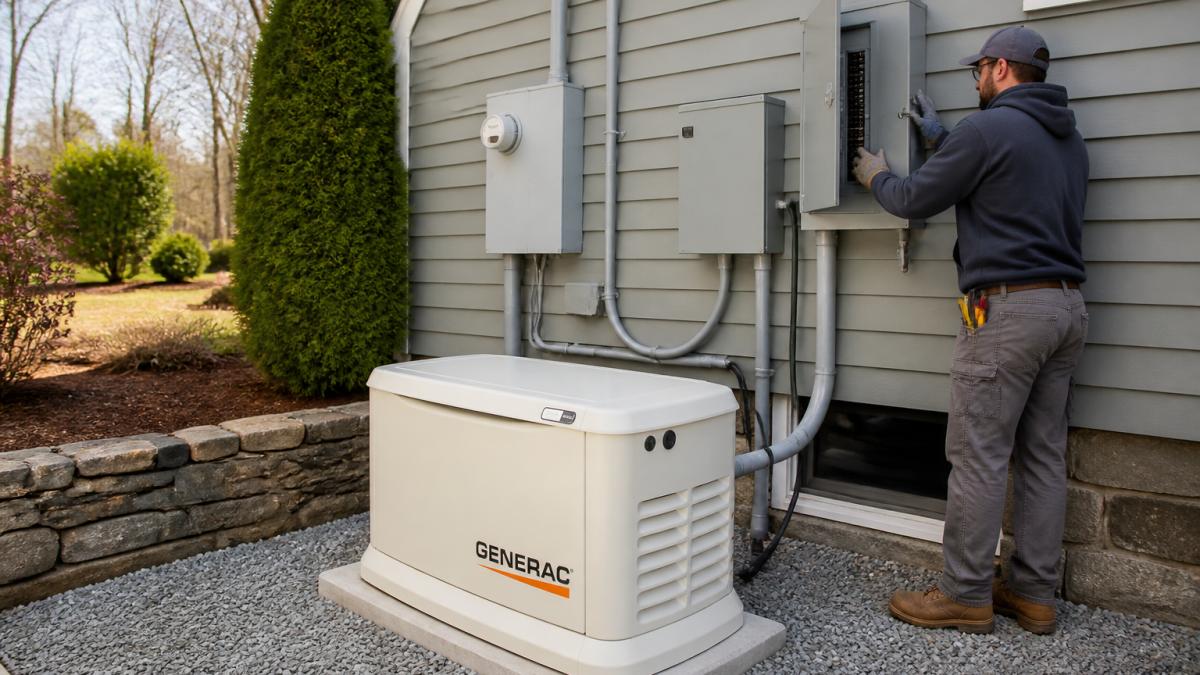
At CNE Electrical, we install Generac standby systems across the North Shore, and the questions homeowners ask rarely change. Will it run the heat? How does it know the power is out?
Automatic Operation When Utility Power Fails
The automatic transfer switch is the component that makes hands-off backup possible. It’s a dedicated switch installed between your utility service and your home’s electrical panel.
That sequence matters for safety. The National Electrical Code treats transfer equipment as a life-safety requirement, not an optional convenience.
For a plain-English walkthrough of the full sequence, from outage detection to power restoration, see how a generator works during a power outage.
What Can a Standby Generator Power During an Outage?
A standby generator can power anything your home needs, provided the system was sized for those loads.
The distinction is planning, not product tier. Sizing starts with a load calculation that accounts for running watts, starting watts on motor-driven equipment, fuel supply capacity, and whether load-shedding devices are part of the design. Square footage alone tells you almost nothing useful.
8 Benefits of a Standby Home Generator, Numbered
Here are the benefits that actually hold up once you’ve lived with a system through a few outage seasons, with the mechanism behind each one, because the “why” is what separates a real benefit from a brochure line.
- Power restored within seconds for essential appliances. The refrigerator and freezer come back on quickly after a brief transfer interruption, so food is unlikely to spoil during a multi-day outage. The transfer switch moves the load to the generator within seconds of a utility drop, short enough in most cases that the compressor doesn’t lose temperature.
- Heating and cooling come back on quickly. Your furnace, boiler, or air conditioning returns to operation after the brief transfer interruption, which matters most during the temperature extremes that tend to cause grid strain in the first place. This is also where sizing gets real: a heat pump with electric backup heat draws far more starting current than a gas furnace, and the load calculation has to account for it.
- No extension cords, no manual start. Nothing needs to be dragged out, fueled, or plugged in. The system activates on its own, whether you’re home or away, the practical difference between a standby unit and a portable one you have to be present to run.
- Reliable power for remote work. A home office, networking equipment, and a Level 2 EV charger circuit can all stay live if the system was designed for those loads. EV charging is a large, continuous load, so whether it belongs on the backup circuit is a planning decision, not an assumption.
- Automatic operation during storms when you can’t respond. Traveling, at work, asleep, it doesn’t matter. The controller handles the start sequence and the transfer switch handles the isolation, with no human in the loop.
- Stable power quality. Utility restoration can bring voltage swings; a properly installed standby system is designed to deliver consistent voltage and frequency to sensitive electronics such as computers, medical equipment, and modern appliances.
- Resilience across longer outages. Fuel supply planning determines how long you can ride out an event. A fixed propane tank or a natural gas connection supports extended runtime far better than portable fuel cans, and the difference shows up on day three of an outage, not hour three. Natural gas depends on utility pressure staying up during a regional event; propane depends on your tank size and how full it was when the storm hit. Neither is automatically better, the right choice depends on your fuel access and how long your outages tend to run.
- Peace of mind. This one gets dismissed as soft, but it’s the reason most homeowners buy. Knowing the sump pump and the heat are backed up changes how you weather a storm, and it’s the benefit that compounds every season you don’t have to think about it.
The benefits that hold up over years are the ones tied to a correctly sized system and a planned fuel supply. A generator that’s undersized or running on a half-full propane tank delivers fewer of these than the list suggests.
Whole-House Generator Pros and Cons: An Honest Look
Whole-house generator pros and cons come down to capability versus commitment. The honest version has to cover what you’re actually signing up for, because the decision is easier to live with when you understood it going in.
The pros, concretely:
- Full-home coverage when sized correctly. A whole-home system carries the calculated load of the house, heating and cooling, well pump, refrigeration, lighting, cooking, and the circuits you actually use, without you triaging what gets power.
- Automatic operation. No fuel handling, no cords, no manual start. The transfer switch and controller do the work whether you’re home or not.
- Extended runtime on a fixed fuel supply. A natural gas connection or a properly sized propane tank supports multi-day outages in a way portable fuel cans cannot.
The cons, just as concretely:
- Higher upfront cost than a portable unit. The cost depends on your calculated load, fuel type, transfer switch configuration, gas line capacity, and site conditions like pad placement and clearances. Pricing varies by project, so contact CNE Electrical for a site-specific estimate.
- A permanent footprint. The unit sits on a pad with code-required clearances from the house, property lines, windows, and vents. Placement is a real design decision, not an afterthought.
- Routine maintenance you have to schedule. Your manufacturer sets the exercise schedule, service intervals, and battery, belt, and fuel system checks, so follow that schedule rather than a generic one. Skipping it is the most common way a system fails on the first cold night.
When a standby generator may not be worth it:
- Outages in your area are rare and brief, and a portable unit covers the few you get.
- You only need backup for one or two circuits, a smaller essential-circuit system or a battery backup may fit better.
- You’re not prepared to keep up with annual service; an unmaintained generator is a liability, not an asset.
Best for: homeowners who want the heat, refrigeration, water, and workspace to keep running without thinking about it, and who will keep up with service.
Skip if: outages are rare and brief, you need backup for one or two circuits only, or you can’t commit to maintenance.
A standby generator is not a set-and-forget appliance. The self-test runs the engine unloaded, so it can pass while the unit still fails under a real load. Budget for annual service from day one.
If you’d like to talk through whether a whole-home system fits your situation, contact us for a site assessment, the conversation starts with your loads and your fuel, not a sales pitch.
Standby Generator vs Portable Generator: Which Fits Your Home?
The standby generator vs portable generator comparison usually settles fast once you look at how each one is actually used. A portable generator is inexpensive, flexible, and requires you to be home, store fuel safely, run extension cords, and manage carbon monoxide risk from exhaust.
| Factor | Standby Generator | Portable Generator |
|---|---|---|
| Startup | Automatic | Manual |
| Fuel | Natural gas or propane | Gasoline, propane |
| Runtime | Limited by fuel supply | Limited by fuel on hand |
| Coverage | Whole home or essential circuits | Cord-connected appliances or selected household circuits when connected through properly installed transfer equipment |
| Installation | Professional, permitted | None |
| Best for | Extended outages, absent homeowners | Short outages, budget limits |
Portable units have a real place, particularly for renters or very occasional outages. Where they fall short is duration and effort. For a deeper side-by-side, read standby versus portable generators.
Home Generator Maintenance: What Keeps It Ready to Run
Home generator maintenance is what separates a system that works when called on from one that sits idle for two years and fails on the first cold night. Standby units run scheduled self-tests, typically weekly, which exercises the engine and confirms the controller is functioning. Those self-tests are not a substitute for annual service.
Maintenance requirements vary by generator model and operating hours. Follow the manufacturer’s recommended service schedule. A qualified technician can inspect the generator, evaluate its condition, and perform appropriate operational testing.
Watch out: skipping the annual service because the generator “always starts” is the most common way homeowners end up with a no-start during an outage. Our generator maintenance guide covers the full service schedule.
Standby Generator Lifespan and What Affects It
Standby generator lifespan typically runs well into the double digits for air-cooled home units, with liquid-cooled models often lasting longer, but the range is wide and the variables are within your control.
An undersized unit running near its limit every outage wears faster than a correctly sized one operating comfortably. Poor pad drainage, inadequate ventilation, or a marginal gas supply line all shorten life.
Schedule a Standby Generator Site Assessment
The only way to know what your home actually needs is a site assessment. Sizing starts with a calculated electrical load, not a guess, and the assessment also confirms fuel supply capacity, transfer switch placement, pad location, and permit requirements for your town.
We’re a Generac Authorized Dealer, and our licensed team walks through the load calculation with you so the recommendation makes sense. If you’d like to explore sizing options before we visit, our backup power estimator gives you a starting point. And if the assessment points to a service upgrade or you’re planning to add a Level 2 charger alongside your backup system, we handle Generac Standby Generator Installation and EV Charger Installation as part of the same conversation.
Frequently Asked Questions
How long does a home standby generator last?
Most home standby generators are built to run for many years, and the standby generator lifespan you get depends heavily on maintenance. Oil and filter changes, annual inspections, battery replacement, and exercising the unit under load all extend service life. Generators kept on a routine maintenance schedule routinely outlast neglected ones by a wide margin. In Massachusetts, salt air and freeze-thaw cycles make annual service more important, not less. CNE Electrical can inspect your unit and recommend a service schedule.
Does installing a standby generator require a panel upgrade?
Not automatically. A standby generator installation depends on calculated electrical loads, starting requirements, fuel supply, and load management, not square footage or the age of the panel alone. An electrician evaluates your existing service capacity and the transfer switch setup before recommending anything. If your panel is undersized or a known problematic model, an upgrade may be part of the project, but it is a finding from a site assessment, not a default add-on. Get a specific evaluation before you assume.
What are the downsides of using a portable generator?
Portable generators cost less upfront, but they come with real tradeoffs. Someone has to be home to set them up, they run on extension cords, and they cannot power hardwired household systems like a furnace or central air without a transfer setup. Fuel storage and refueling during an outage add hassle and safety risk, and carbon monoxide is a serious concern if they are run too close to the house. A standby generator starts automatically and runs on propane or natural gas, so there is no refueling.
How often does a home standby generator need maintenance?
Plan on at least one professional service visit per year, plus routine testing that the unit performs on its own schedule. Home generator maintenance typically includes an oil and filter change, spark plug and air filter inspection, battery check, and a load test to confirm the generator will carry the house when utility power drops. Skipping service is the most common reason a generator fails during an outage. Ask your installer for the manufacturer’s recommended interval for your specific model.
A standby generator is only as good as the assessment behind it, and a system sized on guesswork will either underperform or cost more than it should. CNE Electrical handles the load calculation, transfer switch design, fuel planning, and permitting as one coordinated installation, and we’re a Generac Authorized Dealer with licensed electricians on every job. Get started with CNE Electrical and a site-specific standby generator assessment for your home.
