
Table of Contents
- Does an EV Charger Require a Panel Upgrade?
- How to Assess Your Electrical Panel Capacity
- EV Charger Load Calculation: What You Need to Know
- Adding an EV Charger with a 100-Amp Panel
- Installing an EV Charger When Your Electrical Panel Is Full
- EV Charger Load Management: Alternatives to Panel Replacement
- When a Panel Upgrade Is Necessary
- Checklist Before Requesting an Estimate
- Frequently Asked Questions
Last Updated: October 19, 2026
Does an EV Charger Require a Panel Upgrade?
Not automatically. Whether you need an EV charger panel upgrade depends on three factors: your current electrical service size, the available breaker space in your panel, and your home’s total electrical load. Many homes can accommodate a Level 2 EV charger without upgrading.
The answer matters because a panel upgrade can be a significant part of an EV charger installation cost. Understanding your actual capacity before calling an electrician can help you plan. At CNE Electrical, we assess each home individually because every electrical system is different.
This guide walks you through assessing your panel, calculating your load, and exploring alternatives to a full upgrade. By the end, you’ll know what your home needs.
How to Assess Your Electrical Panel Capacity
Your electrical panel is the hub of your home’s power distribution. It receives power from the utility and divides it among circuits that run everything in your house. To know if an EV charger fits, you need to look at your total service size and how much breaker space remains, but confirming your actual available capacity requires a proper residential electrical load calculation rather than simply adding up breaker ratings.
Finding Your Current Service Size
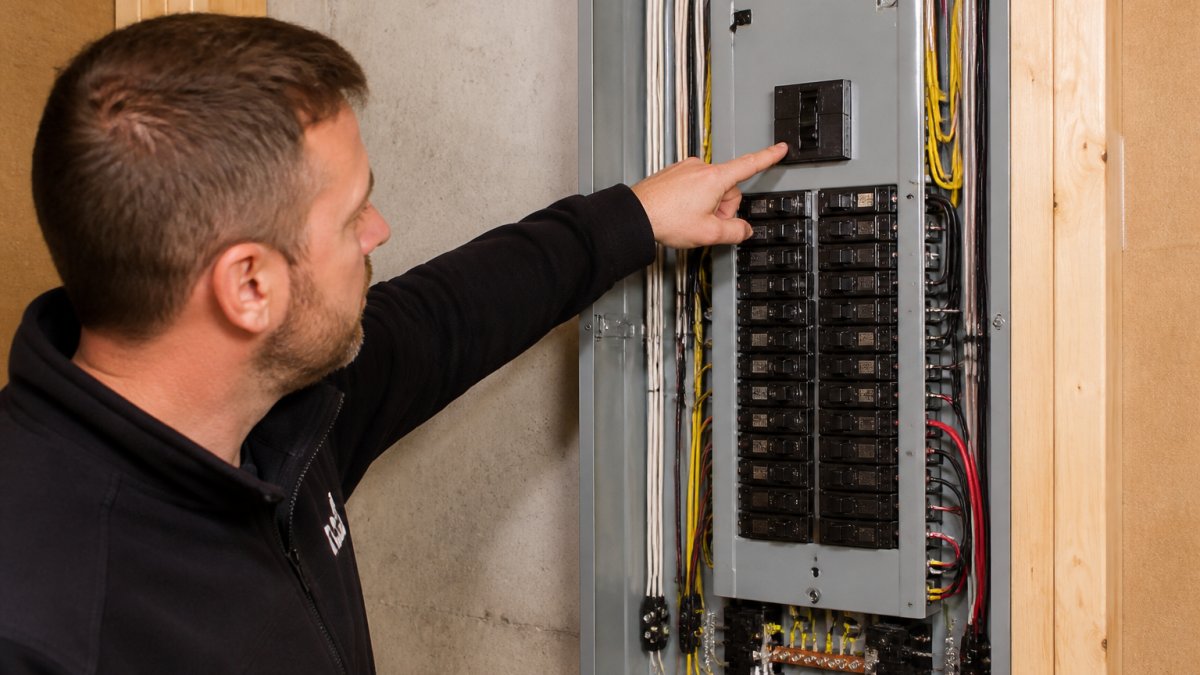
Open your electrical panel and look at the main breaker. It’s the largest switch at the top or side of the panel. The number on it tells you your service size: typically 100 amps, 150 amps, or 200 amps.
A 100-amp service was common in homes built before 1980. Many homes built between 1980 and 2000 have 150 amps. Newer homes often have 200 amps.
Write this number down. It’s your starting point.
Understanding Available Breaker Space
Next, count the open slots in your panel. Each breaker takes one slot. A full panel has no empty slots.
Here’s the catch: even if you have empty slots, you may not be able to use them. Some panels are physically full. Others have tandem breakers (two thin breakers sharing one slot), but adding new ones isn’t always safe or code-compliant.
Open slots tell you about physical space, not about how much electrical capacity you have left. A subpanel can add more circuit spaces, but it does not increase your home’s overall electrical service capacity. To know whether there’s room for an EV charger, you need a proper residential electrical load calculation.
Don’t guess about this. A licensed electrician can tell you what’s actually available in your specific panel.
EV Charger Load Calculation: What You Need to Know
An EV charger draws power continuously while charging, and electrical code generally treats EV charging as a continuous load that must be accounted for under applicable code requirements. The amount depends on which charger type you install.
Level 1 vs. Level 2 Charging Demands
A Level 1 charger uses a standard 120-volt household outlet. It draws about 12-15 amps. Most homes already have circuits for this. Level 1 adds minimal load to your electrical system.
A Level 2 charger uses a dedicated 240-volt circuit. It typically draws 30-50 amps, depending on the charger model and your home’s setup. A 40-amp Level 2 charger is common. This is where panel capacity becomes relevant.
Level 2 charging is faster and more practical for daily use. A typical EV charges overnight at Level 2 in 6-10 hours. Level 1 takes 24-48 hours for the same charge.
Calculating Your Home’s Total Electrical Load
Your electrical load is the total power your home uses at any moment.
But that’s not the whole story. Your EV charger doesn’t run 24/7. Your air conditioner doesn’t run in winter. Your electric water heater cycles on and off.
An electrician calculates your actual demand load using the National Electrical Code formula. This accounts for which appliances run simultaneously. The result is usually lower than adding every circuit together.
If your electrician’s load calculation, including the EV charger as a continuous load under applicable code requirements, stays within your service size, you’re good. If it exceeds it, you have options.
Adding an EV Charger with a 100-Amp Panel
A 100-amp service is tight for modern homes. Adding a 40-amp Level 2 charger to a 100-amp panel is challenging but sometimes possible.
The key is whether a proper electrical load calculation shows enough available capacity, not simply whether a breaker slot is open. A home with a lower calculated load and open breaker space may support a 40-amp charger, while a home already near its calculated capacity will need a different approach.
Many homes with 100-amp service built before 2000 have outdated panels with limited capacity. Federal Pacific panels and Zinsco panels, common in older homes, have known reliability issues. If your home has one of these, upgrading to a modern panel is often the safest choice anyway.
For a 100-amp service, your options are:
- Install a Level 1 charger (minimal load impact)
- Use a properly designed and code-approved EV energy-management system, which may allow charging without a service upgrade depending on the installation
- Install a subpanel for additional circuit space, though this does not increase your home’s overall electrical service capacity
- Upgrade to a higher-capacity service if a load calculation shows it’s needed
Installing an EV Charger When Your Electrical Panel Is Full
A full panel with no open breaker slots doesn’t mean you can’t have an EV charger. It means you need to get creative.
Load Management and Smart Chargers
A smart EV charger communicates with your home’s electrical system. It adjusts charging power based on available capacity. If your air conditioner kicks on, the charger reduces its draw.
This is called load management. A properly designed and approved EV energy-management system may allow you to charge without exceeding your total service capacity, depending on your installation and applicable code requirements. EV charging is generally treated as a continuous load, which must be accounted for under those code requirements. You’re not adding total load to your home. You’re shifting when that load happens.
Smart load management works best if your peak household loads don’t overlap with charging times.
Some chargers also allow you to manually limit their amperage. A 40-amp-capable charger can run at 20 amps or 30 amps instead. This reduces demand but slows charging. You trade charging speed for panel capacity.
Subpanel Installation as an Alternative
A subpanel is a second electrical panel fed from your main panel. It adds breaker slots for additional circuits, but it does not increase your home’s available electrical service capacity.
A subpanel can be a more cost-effective option than a full panel upgrade. You’re not increasing your total service size. You’re just reorganizing how that power is distributed.
Here’s how it works: you run a larger circuit from your main panel to a subpanel in a convenient location. The subpanel then has its own breakers for individual circuits.
A subpanel is practical if your main panel is full but your total service capacity can handle the EV charger. It’s not practical if your actual demand load is already maxed out.
EV Charger Load Management: Alternatives to Panel Replacement
If your panel capacity is tight, you have several ways to make an EV charger work without a full upgrade.
How Smart Load Management Works
Smart chargers monitor your home’s real-time power use. They communicate with your utility or a home energy management system.
When properly designed and approved for your installation, this can help you avoid exceeding your service capacity under applicable code requirements. It also helps prevent circuit breaker trips and keeps your home’s electrical system safe.
Smart load management requires a compatible charger and sometimes a home energy monitor. The monitor measures power flowing in and out of your main panel. The charger receives this data and adjusts accordingly.
For homes with 100-amp or 150-amp service, smart load management can be an affordable option, depending on your installation and applicable code requirements. You may avoid a panel upgrade entirely.
The trade-off is that charging speed varies. On a light day when other loads are low, your EV charges at full speed.
Limiting Charger Amperage and Charging Speed
Another approach is to install a charger rated for lower amperage than your panel can technically support. Instead of a 40-amp charger, you install a 30-amp or 25-amp charger.
This reduces the charger’s peak demand. A 25-amp Level 2 charger still charges most EVs overnight. It just takes an hour or two longer than a 40-amp charger.
This is practical if:
- Your panel has one or two open breaker slots
- Your demand load is near your service limit
- You’re willing to accept slightly slower charging
The electrician runs a smaller circuit to the charger location, uses a smaller breaker, and programs the charger to its lower amperage. The installation can be simpler and less costly than a full panel upgrade.
When a Panel Upgrade Is Necessary
An EV charger panel upgrade is necessary when:
- Your current panel is full with no available breaker space and a subpanel won’t solve your problem
- Your demand load plus the EV charger exceeds your service capacity by a significant margin
- Your panel is an older model with known safety issues (like Federal Pacific or Zinsco)
- You’re planning other major electrical upgrades (heat pump installation, electric water heater, new kitchen circuits) that also need capacity
- Your utility company requires it as a condition of service
A panel upgrade typically means replacing your main service panel with a larger one. For a 100-amp service, this usually means upgrading to 150 or 200 amps. For a 150-amp service, it usually means upgrading to 200 amps.
A panel upgrade can be a significant investment. It typically requires a new meter, new main breaker, new panel, and new utility connections. It also requires multiple inspections and permits.
But sometimes it’s the right answer. If your home is 30+ years old with an undersized panel and you’re adding multiple new electrical loads, a panel upgrade modernizes your entire system. It gives you capacity for future needs.
Checklist Before Requesting an Estimate
Before you contact an electrician, gather this information:
- Your home’s age and the year the electrical system was last upgraded
- Your current service size (check the main breaker)
- Whether your panel has any open breaker slots
- The brand and model of your electrical panel (if visible on the door)
- Your preferred EV charger type (Level 1 or Level 2) and amperage
- Whether you have other planned electrical upgrades (heat pump, water heater, etc.)
- Your utility company’s requirements for EV charger installations (some utilities have specific rules)
Take a photo of your electrical panel with the door open. Include the main breaker and any labeling. This helps an electrician assess your situation before visiting.
Know your peak household loads. If you have an electric water heater, heat pump, or air conditioning, these are your biggest loads. Tell the electrician about them.
Ask the electrician three things:
- Can my current panel handle a Level 2 EV charger, or do I need upgrades?
- If upgrades are needed, what are my options and what does each cost?
- What’s the timeline for installation and any required inspections?
A qualified electrician will assess your specific panel, calculate your actual demand load, and recommend the most practical solution for your home. That solution might be a simple charger installation.
Every home is different. There’s no one-size-fits-all answer.
If you’re ready to explore EV charger installation for your home, CNE Electrical can help. Visit our EV charger installation page to learn more about our process and get started.
Frequently Asked Questions
Can I add an EV charger to a 100-amp panel?
It depends on your home’s existing electrical load and how much capacity remains once your other circuits are accounted for. A 100-amp service can support an EV charger in some cases, but only when a residential electrical load calculation confirms enough capacity is available after your home’s other needs, like heating, cooling, and appliances, are factored in. A licensed electrician can perform this load calculation to determine if a charger fits, or whether an option like load management is a better fit for your home.
How do electricians determine whether a panel can handle an EV charger?
Electricians assess your service size (100-amp, 200-amp, etc.), perform a residential electrical load calculation that accounts for your home’s major appliances and systems, check for available breaker space, and evaluate the charger’s amperage requirements. EV charging is generally treated as a continuous load under electrical code, which affects how the circuit and breaker are sized. For Level 2 chargers, this typically means a dedicated 240-volt circuit. The load calculation confirms your home’s total demand, including the EV charger, won’t exceed your service capacity during normal operation.
Can I add an EV charger if my electrical panel is full?
Yes, there are alternatives to a full panel replacement. A properly designed and approved EV energy-management system can prioritize the charger and limit other loads as needed, depending on your installation and applicable code, or you can limit the charger’s amperage to reduce its draw. A subpanel installed downstream of your main panel can provide additional circuit space, though it does not increase your home’s overall electrical service capacity. Each option has trade-offs in charging speed and cost that a licensed electrician can discuss.
Does installing a Level 2 EV charger require a panel upgrade?
Not automatically. A Level 2 charger typically requires a dedicated 240-volt circuit with 30-50 amps, depending on the charger model, and EV charging is generally treated as a continuous load under electrical code. A residential electrical load calculation determines whether your panel has enough capacity and breaker space for this circuit. If it does, no upgrade is needed. If your service is undersized or your panel is full, you may need to upgrade the main service, add a subpanel for additional circuit space, or use a properly designed and approved load-management system, depending on your installation and applicable code.