
Table of Contents
- What Drives the Cost of Home Generator Installation
- How Generator Sizing for a House Affects Your Quote
- Automatic Transfer Switch Installation and Electrical Panel Work
- Generator Installation Permits and Inspections
- Fuel Type, Operating Costs, and Long-Term Ownership
- How to Read a Standby Generator Installation Estimate
- Comparing Quotes and Avoiding Costly Mistakes
- Conclusion: Getting an Accurate Cost for Your Home
- Frequently Asked Questions
Last Updated: October 8, 2026
What Drives the Cost of Home Generator Installation
The cost of home generator installation comes down to four variables: the unit, the labor, your site conditions, and the electrical work to connect it safely.
At CNE Electrical, we build every estimate from a load calculation and a site assessment, not a square-footage shortcut.
The honest answer to “what will this cost?” is that a standby generator installation estimate reflects your specific home.
To give you a sense of real numbers, CNE Electrical has quoted an 18kW Generac installation around $20,995 and a 26kW Generac installation around $23,000. These are examples of quotes CNE has provided, not guaranteed prices, advertised minimums, or universal starting prices.
Your final installed cost depends on generator size, your electrical service configuration, transfer switch requirements, fuel availability, any gas or propane work needed, installation location, trenching, permits, and site conditions.
Equipment, Labor, and Site Conditions
Three buckets make up nearly every generator installation quote: equipment, labor, and site work.
Equipment covers the generator unit, the automatic transfer switch, and accessories like a concrete pad, battery, or remote monitoring module. Larger kilowatt capacity means higher equipment cost.
Site conditions are where quotes diverge most. Distance to the panel, distance to the gas meter or propane tank, soil and trenching, and the condition of your existing service all affect the final number.
How Generator Sizing for a House Affects Your Quote
Generator sizing for a house is a load calculation, not a square-footage guess. Unit size is set by the total electrical load you want to back up, the starting surge of motor-driven appliances, and how you manage those loads during an outage.
A bigger house does not automatically need a bigger generator, and a smaller house does not automatically get a smaller one. What matters is which circuits you want powered and what it takes to start them.
Load Calculation vs. Square Footage
A proper load calculation adds up the running watts of every appliance and system you want on backup power, then factors in starting requirements.
Load management changes the math. If the generator sheds certain large loads while it runs others, you can often back up more of the home with a smaller unit.
This is also where panel work enters the picture. A standby generator installation connects through an automatic transfer switch, not by backfeeding a breaker.
Automatic Transfer Switch Installation and Electrical Panel Work
Automatic transfer switch installation is the core of a safe standby generator hookup. The switch monitors utility power, automatically starts the generator and switches your home onto it when the grid goes down, then switches back when power returns.
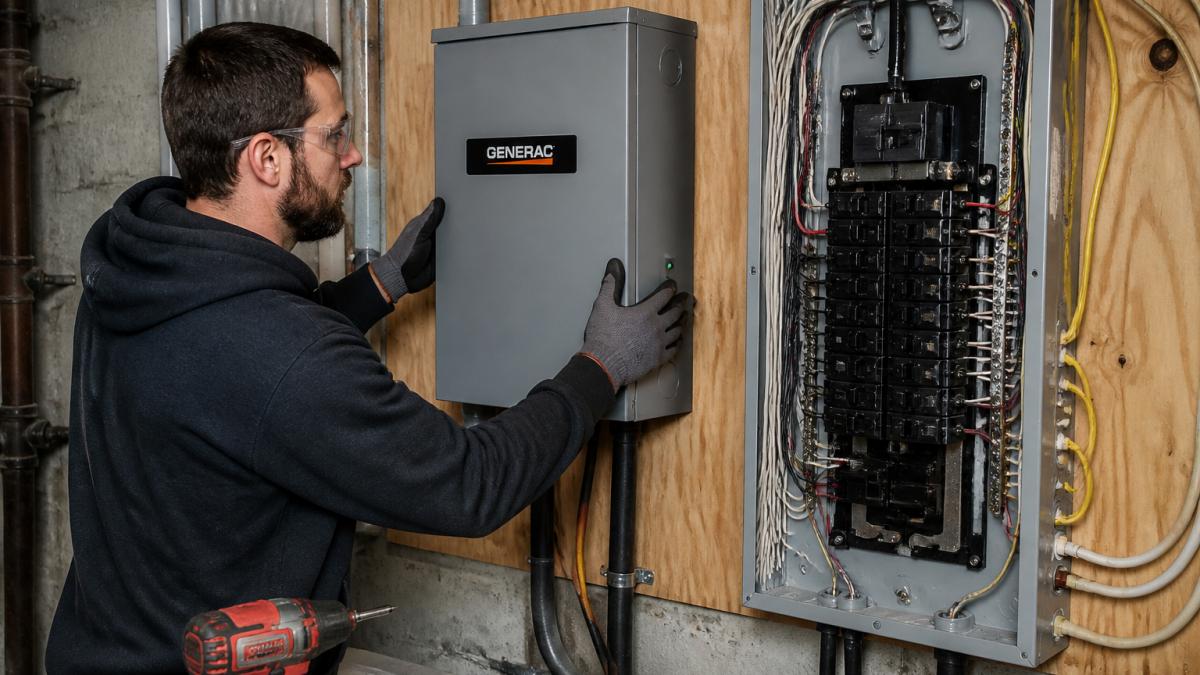
The switch comes in two broad styles. A whole-home transfer switch manages your entire service, while an essential-circuits transfer switch backs up only the circuits you choose, such as heating, a well pump, refrigeration, and a handful of outlets.
Even with a whole-home transfer switch, the generator’s output still sets the limit on what can run at once. Load management lets the system shed or stagger large loads, such as electric water heaters, central air, or an electric range, so the unit is not overloaded, rather than guaranteeing every large load can run at the same time.
Panel condition matters here. If your existing panel has the capacity and configuration to support the transfer switch, it installs alongside the existing panel. Where a panel or service upgrade is needed, the reason is the existing equipment, service configuration, available electrical capacity, transfer switch requirements, and code compliance, not simply the number of open breaker spaces.
Generator Installation Permits and Inspections
Generator installation permits and inspections are required in nearly every municipality and are a line item on your estimate. Permits cover the electrical work and, in most cases, the fuel connection and unit placement. What most online guides skip is the sequence and timeline, where homeowners get surprised.
Who Pulls What
On a typical standby generator project, the licensed electrical contractor pulls the electrical permit. If a gas line is extended or a new propane connection is made, a licensed gas fitter or plumber pulls the gas permit, and in many towns a separate building or mechanical permit covers the pad, trench, and unit placement relative to windows, doors, and property lines.
A Typical Sequence
A common pattern for a residential standby installation looks like this, though the order of electrical work, fuel connections, inspections, and utility coordination can vary by municipality and by project:
- Site assessment and load calculation, before any paperwork, the contractor confirms the unit size, the transfer switch type, and where the unit can legally sit.
- Permit application, the contractor submits the electrical permit and, where required, the gas and building permits. Review times vary widely by town; some issue over the counter, others take a week or more.
- Pre-installation inspection, if required, some jurisdictions want to see the trench, the pad, or the gas rough-in before the unit is set.
- Electrical rough-in and transfer switch installation, inspected before the system is energized.
- Fuel line and generator placement, coordinated with the appropriate licensed gas or propane trade and inspected by the gas authority and, in many towns, the building inspector.
- Final electrical inspection, confirms the completed system, the transfer switch operation, and the labeling.
- Utility coordination, if the home has natural gas, the utility may need to upgrade or confirm the meter and service capacity before the generator can run under load.
Where Projects Actually Stall
Three delays come up again and again:
- Utility gas capacity review. If the existing gas meter or service is undersized for the added generator load, the utility has to review and possibly upgrade it, outside the contractor’s control and potentially weeks of delay.
- Placement and clearance issues. Code clearances from windows, doors, fresh-air intakes, and property lines sometimes rule out the homeowner’s preferred spot, forcing new fuel and electrical runs.
- Inspection scheduling. In busy seasons, getting an inspector on site can take longer than the work itself.
Because permit fees, inspection requirements, and utility rules vary by town, the only reliable number is one built from your address. Contact CNE Electrical for a site assessment and a written estimate that spells out which permits are included.
Fuel Type, Operating Costs, and Long-Term Ownership
Fuel type shapes both the installation and the operating cost of ownership. The two common choices for a standby generator are natural gas and propane. A portable generator runs on gasoline and is a different product entirely: manually set up and connected, not automatic, and not a substitute for whole-home backup.
How Fuel Choice Drives Ongoing Cost
Natural gas is convenient where a line already reaches the home, no tank to refill, no delivery scheduling. The trade-off: during a widespread outage, gas pressure on the utility main can drop, and some generators will not run at full capacity under low pressure.
Propane offers similar day-to-day convenience to natural gas, since the generator still runs automatically during an outage, but it draws from an on-site tank instead of a utility line. That tank has to be sized to the generator’s expected run time and refilled by a propane delivery service, so running low during an extended outage is a real planning consideration. Propane cost tracks market pricing and delivery scheduling rather than a utility rate, which is the main operating-cost difference from natural gas.
A portable generator runs on gasoline, which has a short shelf life and requires manual refueling during an outage. That is a real operating-cost difference: you are the fuel-delivery system.
Maintenance: The Recurring Line Item
A standby generator is a mechanical system with a maintenance schedule that is part of ownership cost. A common pattern:
- Annual service, oil and filter change, spark plug inspection or replacement, air filter, and a general system check.
- Battery replacement, every few years, depending on the battery type and how the unit is exercised.
- Exercise runs, most standby units run briefly on a weekly or biweekly schedule to stay ready, consuming a small amount of fuel.
Skipping maintenance is the fastest way to turn a reliable standby unit into a no-start during the one outage you actually needed it for.
Replacement Horizon
A standby generator is not a lifetime purchase. Its actual service life depends on how well it is maintained, how many hours it runs, the environment it operates in, and the condition of its components over time, not a fixed number of years. The transfer switch and fuel system have their own service lives, shaped by the same factors. When comparing quotes, factor in what the unit will cost to own over its full life, not just what it costs to install.
If you want a clear picture of what a standby generator will cost to own in your home, contact CNE Electrical for a site assessment and a detailed written estimate with one total installed price.
How to Read a Standby Generator Installation Estimate
A standby generator installation estimate should tell you exactly what is included and what is not. Read it line by line, and treat any vague lump sum as a reason to ask questions.
Here is what a detailed installation scope should explain:
- Generator unit: model, kilowatt capacity, and included accessories
- Automatic transfer switch: type and whether it is whole-home or essential-circuits
- Electrical labor: conductors, conduit, terminations, and commissioning
|
Estimate Line |
What It Covers |
Why It Matters |
|---|---|---|
|
Generator unit |
Model, kilowatt capacity, accessories |
Sets your backup capacity |
|
Transfer switch |
Whole-home or essential-circuits |
Determines what stays powered |
|
Electrical labor |
Wiring, conduit, commissioning |
The core install work |
|
Fuel work |
Gas or propane connection |
May be coordinated and included in the project proposal, or contracted separately, depending on scope |
|
Site work |
Pad, trenching, clearances |
Varies most by property |
|
Permits |
Town fees and inspections |
Required, town-specific |
If something is unclear, ask. Compare what is included, what is excluded, the equipment specified, and the warranty, rather than a price broken out by every piece of equipment and every labor hour.
For reference, CNE Electrical has quoted an 18kW Generac installation around $20,995 and a 26kW Generac installation around $23,000. These are examples of specific past quotes, not advertised starting prices or a guaranteed cost for every project. Your final installed price depends on the generator size you choose, your home’s electrical service configuration, transfer switch requirements, fuel availability, any gas or propane work, the installation location, trenching, permits, and overall site conditions.
Comparing Quotes and Avoiding Costly Mistakes
Comparing quotes is where homeowners save the most money, and where they most often go wrong. The lowest number is not always the lowest cost once you account for exclusions, and the highest is not automatically the most thorough. CNE Electrical provides a detailed installation scope and one total project price for each job, rather than a price broken out by every piece of equipment and every labor hour.
A few mistakes we see repeatedly:
- Comparing a whole-home quote against an essential-circuits quote as if they were the same job
- Ignoring whether permits and inspections are included
- Skipping the load calculation and accepting a size based on square footage
Ask each contractor the same questions: What size unit and why? Is the transfer switch whole-home or essential-circuits? Are permits included? Who handles the fuel connection? What is excluded? What warranty is included? What is the total installed price?
Conclusion: Getting an Accurate Cost for Your Home
The only accurate cost of home generator installation is one built from your home’s actual load, fuel access, and electrical condition. Ranges you read online are starting points, not quotes, and anyone who gives you a firm number without a site assessment is guessing.
CNE Electrical is a Generac Authorized Dealer serving the North Shore, and we build every estimate from a load calculation and an on-site review. We handle Generac standby generator installation and the electrical work that supports it, including transfer switch installation and panel evaluations where they are genuinely needed.
If you want a number you can trust, contact CNE Electrical for a site assessment and a detailed written estimate with one total installed price.
Frequently Asked Questions
How much is a generator for a 2,000 sq ft house installed?
There is no single figure because the cost of home generator installation depends on your calculated electrical load, not square footage alone. Two 2,000 sq ft homes can need different kilowatt capacities based on heating systems, well pumps, EV chargers, and central air. A site-specific load calculation, fuel supply assessment, and quote from a licensed electrician are the only way to get an accurate number for your home.
What factors affect the cost of installing a home standby generator?
Key factors include generator size and kilowatt capacity, fuel type (natural gas vs. propane), fuel line distance and trenching, automatic transfer switch installation, electrical panel condition and capacity, site preparation, and local permits and inspections. Homes with older panels, long fuel runs, or limited space for the unit typically see higher installation labor and material costs. A standby generator installation estimate should explain these factors within a detailed scope of work and provide a total installed price.
Does installing a standby generator require a panel upgrade?
Not automatically. Whether a panel upgrade is necessary depends on the condition of the existing electrical equipment, service configuration, available capacity, transfer switch requirements, and code compliance. A lack of spare breaker spaces alone does not mean a panel needs replacing. CNE Electrical evaluates the existing system before recommending upgrades.
How does an automatic transfer switch work?
An automatic transfer switch (ATS) safely disconnects the home from utility power and transfers the selected electrical loads to the standby generator during an outage. When utility power returns, the system transfers back. Depending on the installation, an ATS can serve the whole home or selected essential circuits. Load management can help prevent generator overload by temporarily shedding large electrical loads. Whole-home backup does not necessarily mean every appliance can operate simultaneously.
What should I ask a contractor before getting a generator installation estimate?
Ask whether they are licensed and insured in your state, whether they perform a load calculation rather than sizing by square footage, who handles generator installation permits and inspections, whether the quote clearly identifies the equipment, transfer switch, fuel work, inclusions, exclusions, and total installed price, and what maintenance is required after installation. Also confirm the contractor is authorized by the generator manufacturer, since this affects warranty support.
Is a whole-house generator a tax write-off?
In most cases, a standby generator for a primary residence is not deductible as a federal tax write-off. Some exceptions may apply for medically necessary backup power or certain business use, but rules change and depend on your situation. Consult a qualified tax professional about your specific circumstances rather than relying on general guidance.