
Last Updated: October 30, 2026
Quick Summary
Electrical capacity planning is the process of checking whether your home’s service and panel can safely supply the loads you already have and the ones you plan to add. Running a load calculation before buying equipment such as a heat pump, EV charger, or generator avoids tripped breakers and costly redesigns later.
- Inventory every major load and record its nameplate rating in volt-amperes or amps at a stated voltage.
- Count a continuous load, such as a 40-amp Level 2 EV charger, at 125 percent of its rating.
- Available capacity is what remains after existing loads are counted, not the service amp label alone.
- Service conductors, the meter, and the utility transformer may also need upgrades alongside the panel.
- Get a site-specific load calculation from a licensed electrician rather than relying on a template.
Table of Contents
- Why Home Electrical Capacity Matters Before You Add Equipment
- How to Calculate Your Home’s Electrical Load
- Understanding Your Service Size and Panel Capacity
- EV Charger Electrical Requirements and Your Existing Capacity
- Standby Generator Sizing and Load Management
- Scheduling a Site Assessment With CNE Electrical
- Frequently Asked Questions
Why Home Electrical Capacity Matters Before You Add Equipment
Electrical capacity planning is the process of checking whether your home’s service and panel can safely supply the loads you already have and the ones you plan to add. A common pattern is a homeowner adding a heat pump, an EV charger, or a standby generator without first checking the service, and the problem showing up as tripped breakers, overheated connections, or a project that has to be redesigned. National Electrical Code load calculation requirements
Planning ahead costs far less than fixing an overload after the fact. Load assessment tells you what is possible with your current service, what needs load management, and what requires a service or panel upgrade. Watch out: adding equipment one piece at a time, without a running total, is how most homes end up near their limit without anyone noticing.
How to Calculate Your Home’s Electrical Load
A residential load calculation estimates how much electrical demand your home is likely to place on its service at one time. It combines the connected loads of your appliances and equipment, then applies demand factors that reflect how those loads are unlikely to run at full power simultaneously. The result is compared against your service rating. National Electrical Code load calculation requirements
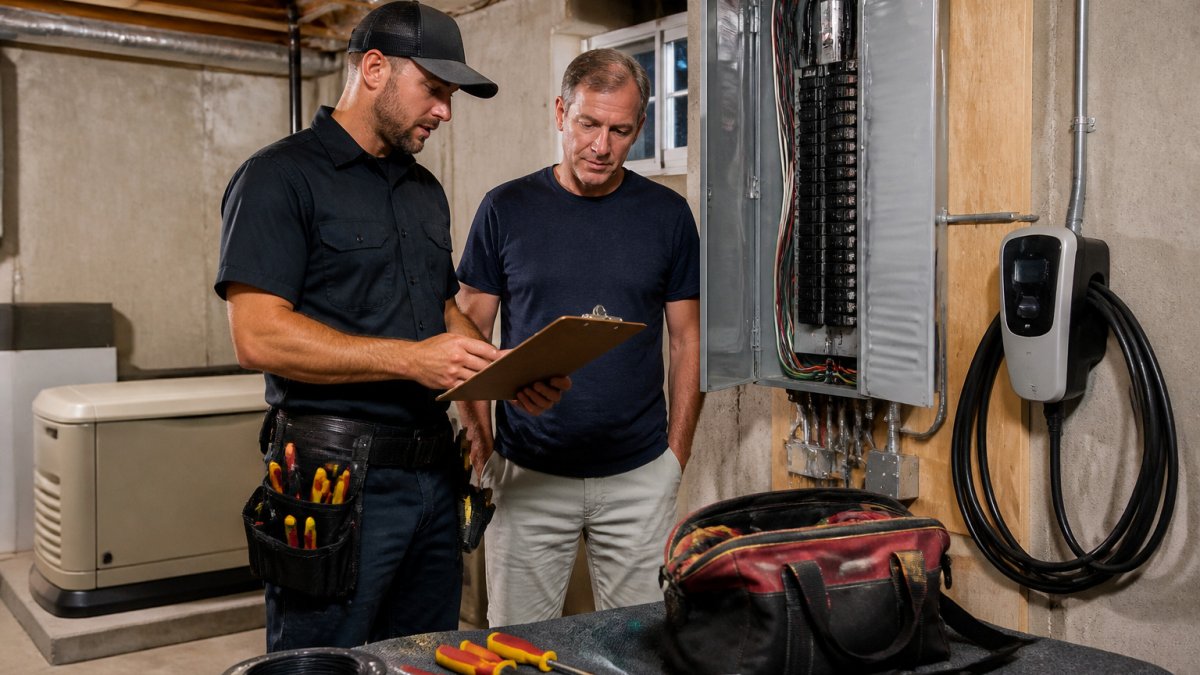
Inventorying Appliances and Equipment
Start with a complete list of fixed and major loads: range, dryer, water heater, HVAC system, heat pump, dishwasher, and any well pump or hot tub. Record the nameplate rating of each, usually stated in watts, volt-amperes, or amps at a stated voltage.
To convert nameplate amps to volt-amperes, multiply amps by the stated voltage. A 240-volt water heater rated at 18.75 amps is 4,500 volt-amperes. A 120-volt circuit rated at 15 amps is 1,800 volt-amperes.
Standard Versus Optional Methods
The NEC provides more than one recognized method for calculating a dwelling’s load, and the method your jurisdiction or utility requires affects the result. The standard method builds the calculation part by part: general lighting and receptacle loads at a set volt-ampere-per-square-foot allowance, small-appliance and laundry branch circuits, then each major appliance and motor load. The optional method is a shorter approach that uses a single calculated load for the general lighting and receptacle portion and applies different demand factors to the remaining loads.
Continuous Versus Noncontinuous Loads
A continuous load is one expected to operate at maximum current for three hours or more. The NEC requires continuous loads to be sized at 125 percent of their rating when calculating branch-circuit and feeder capacity. An EV charger is the classic example in a modern home: a 40-amp Level 2 charger is treated as a 50-amp continuous load for capacity purposes. Noncontinuous loads, such as a range or dryer, are generally counted at their nameplate rating.
A Worked Example With Stated Assumptions
Here is a simplified illustration using the standard method, with every assumption stated so you can follow the steps. These numbers are illustrative only and are not a substitute for a calculation performed on your actual home.
- General lighting and receptacles. A 2,000-square-foot home at the NEC’s 3 volt-amperes per square foot allowance gives 6,000 volt-amperes.
- Small-appliance and laundry circuits. Two 20-amp small-appliance circuits at 1,500 volt-amperes each, plus one 20-amp laundry circuit at 1,500 volt-amperes, gives 4,500 volt-amperes.
- Major appliances. Range at 8,000 volt-amperes, dryer at 5,500 volt-amperes, and water heater at 4,500 volt-amperes.
- Heat pump. A 5,000-volt-ampere heat pump, counted at its nameplate rating.
- EV charger. A 40-amp Level 2 charger at 240 volts is 9,600 volt-amperes, counted at 125 percent as a continuous load, or 12,000 volt-amperes.
Add the connected load: 6,000 + 4,500 + 8,000 + 5,500 + 4,500 + 5,000 + 12,000 = 45,500 volt-amperes. The standard method then applies demand factors to the general lighting and appliance portions, which reduces the total to a design load.
Keep a running list of every large load you add, with its nameplate rating and voltage. A homeowner who can hand an electrician a complete inventory gets a faster, more accurate assessment than one who has to reconstruct it from memory.
Why the Calculation Matters Before You Buy
A load calculation tells you whether a planned addition fits your current service, whether load management could make it fit, or whether a service upgrade is the honest answer. Running it before you buy the equipment avoids the pattern we see most often: a heat pump, EV charger, or generator installed one piece at a time until the service is at its limit and the next project has to be redesigned.
The table below summarises the worked example’s load steps as the article states them, so you can scan the running total.
| Load item | Value | Note |
|---|---|---|
| General lighting and receptacles | 6,000 VA | 2,000 sq ft at 3 VA per sq ft |
| Small-appliance and laundry circuits | 4,500 VA | Two small-appliance and one laundry circuit |
| Range | 8,000 VA | Major appliance |
| Dryer | 5,500 VA | Major appliance |
| Water heater | 4,500 VA | Major appliance |
| Heat pump | 5,000 VA | Counted at nameplate rating |
| EV charger | 12,000 VA | 40 A Level 2, counted at 125 percent |
| Total connected load | 45,500 VA | Before demand factors are applied |
Understanding Your Service Size and Panel Capacity
Your service rating, commonly 100 amps, 150 amps, 200 amps, or 320 amps in older or larger homes, is the maximum current the utility service can deliver. Check the warning signs that your service may be undersized before adding new equipment. A service can be larger than the panel’s practical limit, so both matter. Massachusetts electrical code and utility service guidance
What Each Service Size Realistically Supports
A 100-amp service was standard for decades and is common in older homes. It can often support a gas range, gas dryer, and gas water heater alongside a central air conditioner, but adding a Level 2 EV charger or a large heat pump can push a 100-amp service past its practical margin in many homes. A 150-amp service typically offers more headroom. Whether a given service size can absorb a new electric load is not a fixed rule: it depends on a proper load calculation performed by a licensed electrician, not a generic guideline.
Available Capacity Is What Remains
Many homeowners assume a higher amp rating automatically means more usable capacity. In practice, available capacity is what remains after existing loads are accounted for in a proper load calculation, the methods for which are set out in NEC Article 220. The National Electrical Code also requires continuous loads, those expected to run for three hours or more, to be sized at 125% of their rating, which further reduces the margin left on a service. A 200-amp service with a large heat pump, electric range, electric water heater, and EV charger can be closer to its limit than a 100-amp service with mostly gas appliances.
The Utility Side: Meter, Service Conductors, and Transformer
Panel capacity is not the only constraint. The service drop or service lateral, the meter socket, and the utility transformer all have to support the load you are adding. A service upgrade is a coordinated project: the electrician replaces the panel and service equipment, but the utility may need to upgrade the service conductors, the meter, or the transformer that feeds the home. This coordination is why a service upgrade timeline is often driven by utility scheduling as much as by the electrical work itself. utility service and interconnection guidance
Do not assume a panel swap alone increases your capacity. If the service conductors or meter socket are not rated for the higher amperage, the upgrade is incomplete and may not pass inspection.
Panel Change Versus Service Upgrade
A panel change replaces the main panel and breakers, often to gain breaker space, replace a recalled or obsolete panel, or add a transfer switch for a generator. A service upgrade changes the service rating itself, which involves the meter, service conductors, and utility coordination. A generator installation does not automatically require either one; whether a panel change or service upgrade is needed depends on the load calculation and the transfer switch design.
When an Upgrade Is the Honest Answer
An upgrade is worth discussing when the calculated load approaches the service rating, when the panel has no space for the circuits you need, when the existing panel is obsolete or has known safety issues, or when your electrification plans (heat pump, EV charger, induction range, heat pump water heater) will add load faster than load management can absorb it.
EV Charger Electrical Requirements and Your Existing Capacity
A Level 2 EV charger typically draws a continuous load, which the NEC requires to be sized at 125% of the charger’s rated amperage for the branch circuit and breaker, and it is usually the single largest addition that pushes a home toward its limit. Learn whether your EV charger needs a panel upgrade and how capacity assessment and alternatives are handled.
Plan the charger and any planned generator together so their combined demand is evaluated at once rather than sequentially. If you have questions about your specific panel, our EV charger installation service is a good place to start.
Standby Generator Sizing and Load Management
Generator sizing depends on calculated electrical loads, starting requirements for motors such as the HVAC compressor, fuel supply, and which circuits you intend to back up. Use a backup power estimator for Massachusetts homes to explore recommended sizing options. A standby generator does not automatically require a panel upgrade; whether one is needed depends on the calculation and the transfer switch design. UL standard for transfer equipment
Load management, which sequences or limits large loads during an outage, is an alternative to oversizing the generator or the service. Once installed, a generator needs ongoing care: maintenance requirements vary by generator model and operating hours, so follow the manufacturer’s recommended service schedule and have a qualified technician inspect and test it. See how to maintain a standby generator for more guidance. Our Generac standby generator installation service can review your loads before recommending a size.
Scheduling a Site Assessment With CNE Electrical
A site assessment is the most reliable way to know your home’s real capacity. A site assessment reviews your service, panel, existing loads, and planned additions, then explains which options may fit your situation.
Contact CNE Electrical to schedule an assessment before you add your next major load. Planning your capacity now means your EV charger, generator, or heat pump works as intended from the first day.
Frequently Asked Questions
How do I calculate my home’s electrical load?
Start by listing every major appliance and piece of equipment, noting its nameplate wattage or amperage and how often it runs at the same time as others. NEC Article 220 sets out more than one calculation method, including a standard method and, for qualifying dwellings, an optional method, and electricians apply demand factors from the applicable method to estimate the realistic peak demand rather than adding every load together. Because the method and the loads involved depend on your specific equipment and service, a licensed electrician can run a formal calculation during a site assessment.
How can I tell whether my electrical panel has enough capacity?
Check the panel’s amperage rating, usually printed on the main breaker or label, and look for open slots for new breakers. Signs of strain include breakers that trip often, flickering lights when large appliances start, and a panel that is already crowded with no room for expansion. A calculated load compared against the service rating is the reliable way to confirm capacity, and an electrician can do this during an assessment.
What is the difference between electrical service capacity and panel capacity?
Service capacity is the total amount of power the utility’s service drop, meter, and service conductors can deliver to your home, often rated at 100A, 150A, 200A, or higher. Panel capacity is the rating of the distribution panel that splits that power into branch circuits. The panel cannot safely carry more than the service feeding it, so both ratings need to be considered when planning additional equipment.
Can my home support an EV charger without a panel upgrade?
Sometimes. Many homes have enough spare capacity for a Level 2 charger once the existing load is calculated, while others may need load management, a dedicated circuit, or a service or panel upgrade. Installers evaluate the calculated load, the charger’s continuous current draw sized at 125% as required by the NEC for continuous loads, and the panel’s available breaker space. Pricing and scope depend on the site, so request a site-specific estimate from CNE Electrical.
How do I plan electrical capacity for a standby generator?
Generator sizing starts with the loads you want backed up, including their starting requirements for motors and compressors, rather than square footage alone. The automatic transfer switch determines which circuits receive backup power. A calculated load and a load management approach are used to decide whether the generator can carry the selected circuits without overloading. CNE Electrical can review your loads and recommend an appropriate size on site.
What appliances should I include in a home electrical load calculation?
Include the heating and cooling system, water heater, range or cooktop, clothes dryer, electric vehicle charger, pool or spa equipment, and any workshop tools or home office equipment on dedicated circuits. Lighting and general receptacle loads are typically calculated using standard code methods rather than every outlet. Planned future equipment, such as a heat pump or additional charger, should also be considered in the planning stage.
When should I ask an electrician to assess my home’s electrical capacity?
Consider an assessment before adding a generator, EV charger, heat pump, or other large electric equipment, after frequent breaker trips, or when the home has an older panel with limited spare slots. A licensed electrician can measure your actual service, verify the panel rating, and calculate the load under the applicable code. Contact CNE Electrical to schedule a site assessment and get a clear picture of your options.
