
Last Updated: October 26, 2026
Quick Summary
A panel upgrade usually takes a crew roughly 4 to 8 hours on site for a straightforward replacement, with power off for a few hours. The full project timeline from first call to final inspection often runs several weeks because permits, utility coordination, and inspections add waiting time.
- Most residential panel replacements run with a two-person crew, with larger jobs possibly adding a third person.
- Plan for most of a workday with the power off to be safe during the swap.
- Permit review can take a few business days to a couple of weeks depending on the building department.
- Utility coordination for meter or disconnect work can take days to weeks on the utility’s schedule.
- Clear a few feet of space around the panel and meter before the crew arrives.
Table of Contents
- The Short Answer: Hands-On Time vs. Full Project Timeline
- Electrical Panel Replacement Time: What Drives the Hours
- The Electrical Panel Upgrade Process, Step by Step
- How Long Is Power Off During Panel Replacement?
- Panel Upgrade Permit and Inspection: The Scheduling Wildcard
- What Delays a Panel Upgrade, and How to Reduce Overruns
- How to Prepare Your Home Before the Electrician Arrives
- Schedule a Panel Assessment with CNE Electrical
- Frequently Asked Questions
The Short Answer: Hands-On Time vs. Full Project Timeline
A panel upgrade replaces your home’s main electrical service panel, the metal box holding the circuit breakers that distribute power through the house. The hands-on work usually takes a crew one workday, but the full project timeline from first call to final inspection often runs several weeks.
Here is the split we see most often:
- Crew on site: roughly 4 to 8 hours for a straightforward replacement
- Power off: usually a few hours, sometimes most of a workday
- Permit, utility, and inspection scheduling: the biggest variable, often days to weeks
If you are wondering whether your own panel even needs replacing, our guide to the signs you need a panel upgrade walks through the warning signs before you book anything.
Electrical Panel Replacement Time: What Drives the Hours
The hours depend on what the crew finds once the cover comes off. A clean like-for-like swap moves fast; new feeders, grounding work, or code corrections take longer.
Three things move the clock most:
- Service capacity changes, such as moving from an older service to a larger one
- Existing wiring condition, including aluminum branch circuits or past DIY work
- Code corrections the inspector will require before sign-off
None of these can be confirmed from a photo. A site assessment is the only reliable way to estimate hours.
Simple Swap vs. Complex Upgrade
A simple replacement keeps the existing service capacity and sound wiring: the crew removes the old panel, installs the new one, and reconnects the circuits.
A complex upgrade means something else changes too. If an EV charger is the reason for the work, our article on whether an EV charger requires a panel upgrade explains when the charger alone forces the change and when it does not.
Crew Size and Labor Hours
Most residential panel replacements run with a two-person crew. One electrician handles the panel work while the second manages materials, the meter area, and safety.
Larger jobs may bring a third person, but more hands do not always shorten the day, the power still has to come off, and the inspection still has to happen.
The Electrical Panel Upgrade Process, Step by Step
The electrical panel upgrade process generally moves from assessment to final approval, though the exact order and requirements vary by project and local jurisdiction. Skipping a required step can lead to a failed inspection and a return visit.
Here is a typical sequence, though the specifics depend on the project and local requirements:
- Site assessment. Confirm capacity, wiring condition, and what the job actually requires.
- Permit application. File with the local building department.
- Utility coordination. Schedule any meter or service disconnect work.
- Installation day. Remove the old panel, install the new one, reconnect circuits.
- Inspection. The local inspector reviews the work.
- Final approval and utility reconnect. Power is restored and the job closes out.
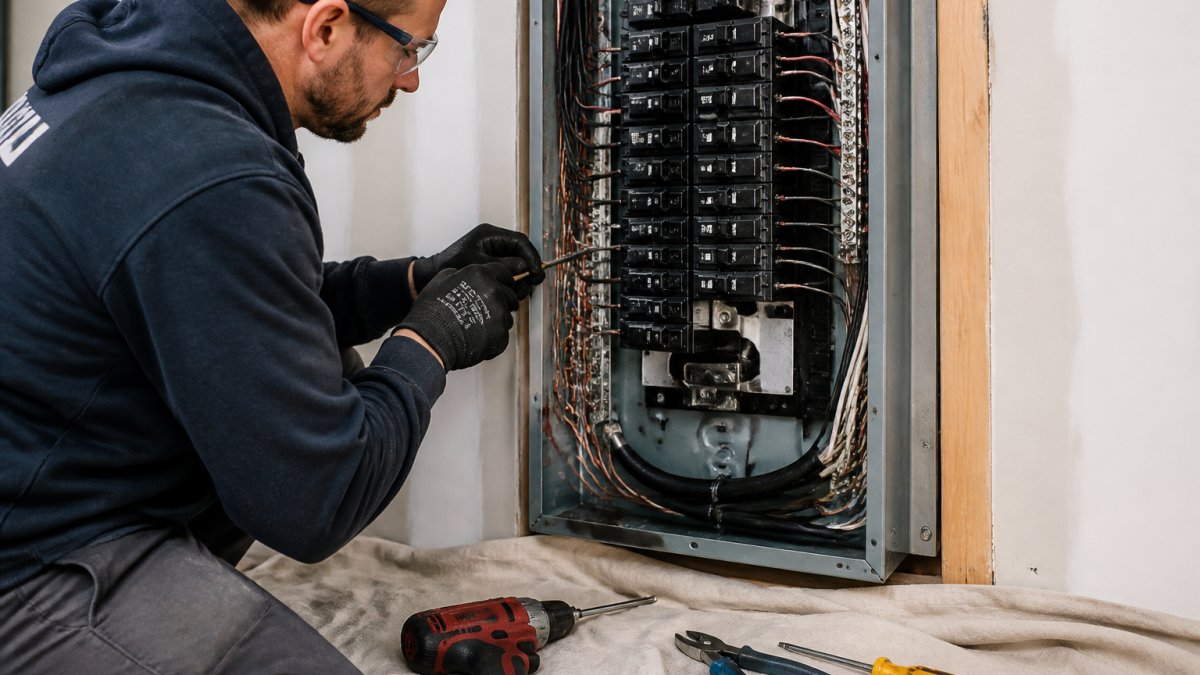
What Happens on Installation Day
The crew arrives, sets up, confirms the plan, and the power comes off. From there the work generally follows a similar pattern: label circuits, disconnect the old panel, mount the new one, land the conductors, torque the terminations, and test the work. The exact sequence can vary by project. Before leaving, the crew reviews the panel and confirms it is ready for inspection.
How Long Is Power Off During Panel Replacement?
Power is typically off for a few hours during the swap. Plan for most of a workday to be safe.
That is the general answer to how long is power off during panel replacement in most homes: the main disconnect stays open while the crew works inside the panel, though actual timing varies by project. Note that opening the main breaker does not necessarily de-energize the incoming service conductors from the utility. Where those conductors remain live, proper utility disconnection and verification are required before work begins.
What to plan around:
- Refrigerators and freezers: keep doors closed; a few hours is generally fine
- Medical equipment: tell the crew in advance so they can plan around it
- Work-from-home setups: schedule the day off or plan a backup location
If a generator is part of your plan, ask during the assessment.
Panel Upgrade Permit and Inspection: The Scheduling Wildcard
The panel upgrade permit and inspection steps are where most of the calendar time goes. The electrical work is fast; the paperwork and scheduling are not. Separate active work time (a crew on site) from waiting time (the job sits in someone else’s queue).
Here is how the two stack up for a typical residential replacement:
| Stage | Who controls it | Typical duration | Active or waiting |
|---|---|---|---|
| Permit application and review | Local building department | A few business days to a couple of weeks | Waiting |
| Utility coordination for meter or disconnect | Your utility | Days to weeks, depending on their schedule | Waiting |
| Installation day | Your electrical contractor | Roughly 4 to 8 hours | Active |
| Rough or final inspection | Local inspector | Same day to several business days after the request | Waiting |
| Utility reconnect and meter seal | Your utility | Same day to a few business days | Waiting |
Read that table as a sequence, not a sum. Some steps overlap, the permit can be filed while the utility appointment is scheduled, but the inspection cannot happen until the work is done, and the utility will not finalize service until the inspection is approved.
Why the Permit Step Takes as Long as It Does
A permit application is not a formality. The building department reviews the scope, confirms the proposed service capacity, and checks that a licensed electrician will do the work.
A complete, accurate application moves faster than a vague one, one reason the site assessment matters: the permit should describe what the job actually is, not a guess.
Why the Inspection Step Is Not Instant
Once the crew finishes, the work is ready for inspection, but “ready” and “inspected” are different things. The inspector has to be scheduled, and availability varies by area and season. If the inspector flags a correction, the crew returns, fixes it, and the job re-enters the inspection queue, a second waiting cycle, not a second installation day.
Ask your contractor whether the inspection is requested the same day the work is completed. A job that waits a week to request inspection adds a week to the calendar for no technical reason.
Why the Utility Has Its Own Clock
Any work involving the meter, service disconnect, or service drop involves the utility, which schedules on its own timeline. It may need to disconnect service before the crew can safely work, and must reconnect and reseal the meter before the job is truly closed.
We cannot promise a timeline for your town, and any contractor who does is guessing. For quick answers on permits and inspections, our FAQ page covers the common safety and process questions.
The Itemized Timeline, Start to Finish
Pulling the pieces together, here is a typical project schedule. Actual timelines vary by project scope, the local permitting office and utility scheduling.
- Week 0: Site assessment and scope confirmation.
- Week 0-1: Permit application filed; utility coordination begins.
- Week 1-3: Permit review and utility scheduling (waiting time).
- Installation day: Crew on site roughly 4 to 8 hours; power off for most of that window.
- Day after installation to a few days later: Inspection requested and completed.
- After inspection approval: Utility reconnect and meter reseal; job closes out.
The hands-on work is one day; the project is the whole chain. Planning around the chain, not just installation day, keeps a panel upgrade from turning into a surprise.
What Delays a Panel Upgrade, and How to Reduce Overruns
Most panel upgrades finish on the quoted schedule. The ones that run long trace back to a handful of causes, each adding a different kind of time, some add hours on installation day, some add days or weeks to the calendar.
Cause 1: Hidden Conditions Behind the Cover
This is the hardest to predict and the most common mid-job surprise.
What it adds: hours to days of active work, plus a possible second permit review and a second inspection cycle.
How to reduce it: get the site assessment done before scheduling. A thorough assessment opens the panel, checks the service entrance, and looks at the wiring the crew will actually touch.
Cause 2: Code Corrections the Inspector Requires
An inspector reviews the work against the code in effect at permit time.
What it adds: a return visit and a second inspection cycle, which is calendar time more than work time.
How to reduce it: ask during the assessment what code corrections are likely given the age and condition of the service. A contractor who has worked in your area knows what local inspectors commonly flag.
Cause 3: Equipment Availability
The panel, meter socket, breakers, and any specialty components must be on hand on installation day. Supply conditions for electrical equipment have been uneven in recent years, and a specific panel model or breaker type can be backordered.
What it adds: days to weeks of waiting time, entirely before installation day.
How to reduce it: confirm during scheduling that the equipment is secured, not just ordered. Ask whether the quoted panel model is in stock.
Cause 4: Inspection and Utility Scheduling
As covered above, the inspection and the utility reconnect each sit in someone else’s queue. A technically complete job can still wait days for an inspector or a utility appointment.
What it adds: days of waiting time after the work is done.
How to reduce it: request inspection the day the work is completed, and confirm the utility appointment before installation day rather than after.
Cause 5: Access and Site Readiness
A crew that cannot reach the panel, meter, or work area loses time on installation day. Stored boxes, shelving, furniture, and pets all slow the job down. This is the easiest cause to eliminate, and it is entirely in the homeowner’s control.
What it adds: hours on installation day.
How to reduce it: clear the work area before the crew arrives. The preparation checklist below covers the specifics.
Skipping the site assessment to save time is the most common cause of a mid-job surprise. The crew finds a problem on installation day, and the job stops while parts and a revised permit are sorted out. The assessment is the step that prevents the overrun, not the step that causes it.
The Overrun Checklist
Before installation day, confirm each of these:
- Assessment done first. Scope confirmed before scheduling.
- Equipment secured. The panel and breakers are on hand, not backordered.
- Access clear. The panel and meter area are reachable.
How to Prepare Your Home Before the Electrician Arrives
Preparation is simple and saves time on installation day: clear the work area, move fragile items, and make sure the crew can reach the panel and meter.
Use this checklist:
- Clear at least a few feet of space around the panel
- Move stored boxes, shelving, and furniture out of the work area
- Unplug sensitive electronics before the power goes off
Schedule a Panel Assessment with CNE Electrical
At CNE Electrical, we are a licensed electrical contractor and a Generac Authorized Dealer serving homeowners across the North Shore.
When you are ready to move forward, our electrical panel upgrade service covers the scope and next steps.
Get started with CNE Electrical for a clear scope, a realistic timeline, and a site-specific estimate before the work begins.
Frequently Asked Questions
How long does an electrical panel upgrade usually take?
Timelines vary by project, but as a general estimate, straightforward panel replacements often take about 4 to 8 hours of hands-on work, sometimes fitting into a single workday. A job that involves a service capacity increase, new grounding, or rewiring may take longer. The full project timeline, from initial consultation and site assessment through permit, utility coordination, and final inspection, can stretch across several weeks depending on local requirements, even though the electrician may only be on site for a day or two.
How long will the power be off during a panel upgrade?
Power outage duration varies by project, but as a general estimate, plan for the power to be off for most of installation day, often 4 to 8 hours, since the service panel is the main distribution point for the whole house. Turning off the main breaker stops power to the branch circuits, but it does not necessarily de-energize the incoming service conductors from the utility, so proper utility disconnection and verification are required before that part of the panel is opened up. Power is restored only after the new panel is wired and checked. If utility coordination is needed for a service capacity change, a separate scheduled outage window may apply.
Does a panel upgrade require a permit and inspection?
Yes. A panel replacement is permitted electrical work, and the local building department inspects it before the job is considered complete. The permit application, scheduling the inspection, and any corrections the inspector requests all add calendar time beyond the installation itself. In Massachusetts, utility coordination may also be required when the service capacity changes, which is another scheduling step to plan for.
Do I need to leave my home during a panel upgrade?
Most homeowners stay home. The work is confined to the panel area, and the electrician will let you know when power goes off. Expect no electricity for several hours, so plan around refrigerated food, work-from-home setups, and medical equipment that depends on power. If your panel is in a tight space or contains known hazards, the electrician may recommend clearing the area and keeping children and pets away during the work.
