
Table of Contents
- How to Maintain a Standby Generator: Start With the Owner’s Manual
- Your Standby Generator Maintenance Schedule: Monthly, Annual, and Seasonal Tasks
- The Standby Generator Exercise Cycle: What It Does and What to Watch For
- Generator Maintenance Checklist: What to Inspect Each Month
- Standby Generator Troubleshooting: Alarms, Failed Exercise Cycles, and Starting Problems
- Transfer Switch and Whole-Home System Checks
- Maintenance Logs, Service Records, and Knowing When to Call a Professional
- Frequently Asked Questions
Last Updated: October 14, 2026
How to Maintain a Standby Generator: Start With the Owner’s Manual
A standby generator is a permanently installed backup power system that starts on its own when utility power fails, and keeping it ready comes down to following the manufacturer’s maintenance schedule for your exact model.
Generic advice gets people into trouble here. One brand may call for an oil change after a set number of running hours, while another may specify a different interval entirely.
Below, we break down what to check monthly, what to handle yearly, and when to call a licensed electrician instead of reaching for a wrench.
Where to Find Your Model’s Maintenance Intervals
Your maintenance intervals live in the owner’s manual, usually in a table near the back titled “Maintenance Schedule” or “Service Intervals.” Find your model and serial number on a plate inside the enclosure, then match it to the correct manual.
Look for these entries:
- Oil change interval, listed in running hours or months
- Air filter inspection and replacement timing
- Battery check and replacement guidance
Write those intervals on a sticker inside the enclosure lid. You will actually follow them if they are in front of you.
Safety Steps Before Any Inspection
Shut the unit down and let it cool before you touch anything. A standby generator runs hot, and the exhaust and engine surfaces stay dangerous for a while after shutdown.
Before any inspection:
- Set the generator to Off, not Auto
- Let the engine cool completely
Never open the transfer switch yourself. That equipment carries live utility voltage, and it belongs to a licensed electrician.
The most common serious mistake is checking oil or filters while the unit is still in Auto mode. If utility power drops mid-inspection, the generator can start with your hands inside the enclosure. Always switch to Off first.
Your Standby Generator Maintenance Schedule: Monthly, Annual, and Seasonal Tasks
A workable standby generator maintenance schedule splits into three buckets: quick monthly checks, deeper annual service, and seasonal prep before storm season. Most of the monthly work takes under fifteen minutes.
Here is how the tasks break down:
| Task | Frequency | Who Does It |
|---|---|---|
| Visual inspection and operating status check | Per owner’s manual | Homeowner |
| Oil level check | Per owner’s manual | Homeowner |
| Air filter and battery inspection | Per owner’s manual | Homeowner |
| Enclosure cleaning and debris removal | Per owner’s manual | Homeowner |
| Oil and oil filter change | Per manual interval | Homeowner or technician |
| Full annual service and transfer switch check | Per owner’s manual | Qualified technician |
| Pre-season readiness check | Seasonal | Homeowner or technician |
The monthly items are simple. The annual service is where a qualified technician earns their keep, because it covers the transfer switch, valve adjustments, and load testing that homeowners should not attempt.
General Guidance vs. Your Model’s Actual Intervals
The table above is general guidance, not a substitute for your owner’s manual. Manufacturers publish different intervals for different models, and the manual is the only schedule that applies to your unit.
When the manual and a generic article disagree, the manual wins. If you cannot find your manual, look up the model and serial number on the plate inside the enclosure and pull the digital version from the manufacturer’s site.
A Printable Maintenance Log You Will Actually Use
A simple log protects your warranty and your wallet. Record the date, the task, the running-hour reading, and any alarm codes every time you touch the unit. A printable checklist taped inside the enclosure lid works better than an app you forget to open.
Keep these columns in your log:
- Date of service
- Task performed (oil, filter, battery, exercise cycle, annual service)
- Running-hour reading at the time
If you sell the home or file a warranty claim, that log is the first thing anyone asks for.
Where DIY Stops and a Technician Starts
Homeowners can perform routine visual checks, monitor generator status and alerts, keep the surrounding area clear, and perform additional maintenance tasks only when specifically permitted by their generator’s owner’s manual.
- Transfer switch testing and any work inside the transfer switch enclosure
- Fuel connection inspection on propane or natural gas units
- Valve clearance adjustments
If you are unsure which side of that line a task falls on, treat it as technician work. The cost of a service call is far less than the cost of a mistake on live utility equipment or a fuel line.
Build your schedule around three anchors: the routine walk-around, the technician service your manual recommends, and the pre-season readiness check. Follow your owner’s manual for the exact intervals and tasks for your specific model.
The Standby Generator Exercise Cycle: What It Does and What to Watch For
Most standby generators include an automatic exercise cycle, a self-test that runs the unit for a short period to confirm it starts and produces power. The schedule and duration vary by manufacturer and model, so check your owner’s manual or the unit’s control panel settings to see your generator’s actual schedule.
During the cycle, the unit starts on its own, runs briefly, and shuts down. You do not need to do anything. Just pay attention to what happens.
What to watch for:
- It starts within a few seconds. A slow crank points to a weak battery.
- It runs smoothly. Rough running can mean old fuel or a spark issue.
- It returns to Auto mode afterward. If it stays off, you have a problem.
If the cycle fails or the unit does not start, note the date and the alarm code. That record saves your technician time and you money.
A normal exercise cycle does not necessarily verify transfer-switch operation or the generator’s ability to support the home’s electrical loads during an outage. A qualified technician can perform appropriate operational testing to evaluate system readiness.
Generator Maintenance Checklist: What to Inspect Each Month
A good generator maintenance checklist covers five areas: oil, air filter, battery, fuel, and the enclosure itself. Your owner’s manual sets the inspection interval for your specific model; checking these areas on that schedule helps you catch problems before they strand you in an outage.
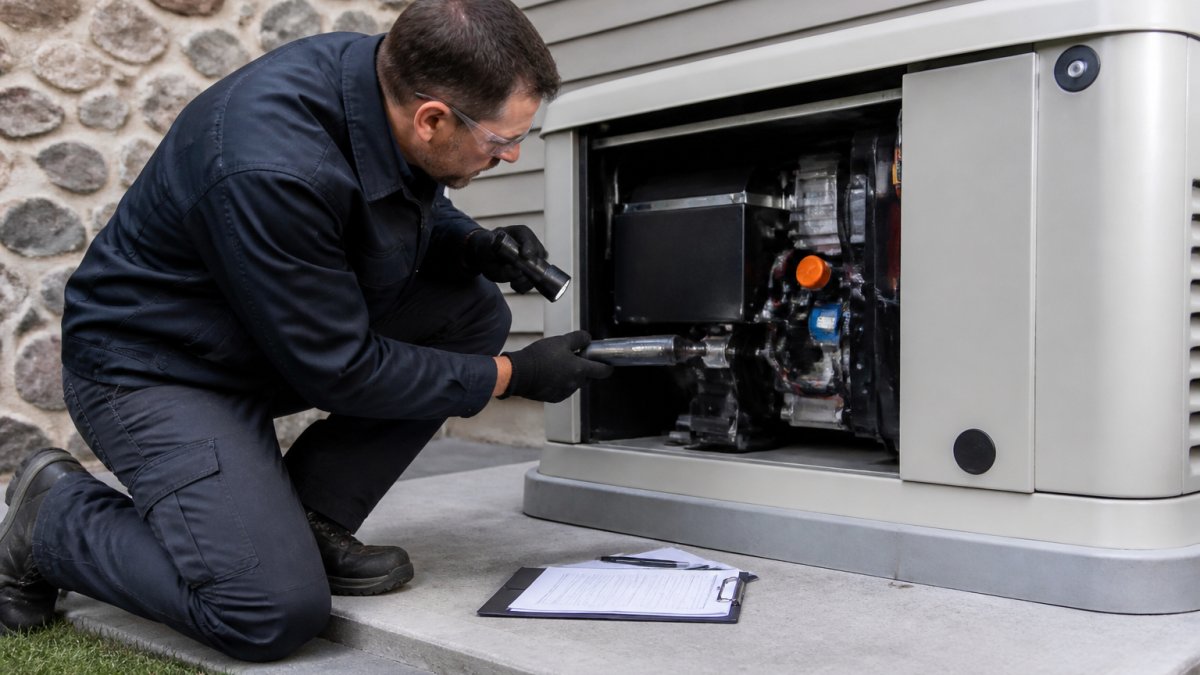
Before you start any check, set the generator to Off, not Auto, and let it cool. If utility power drops while your hands are inside the enclosure, an Auto-mode unit can start on its own.
Oil Level, Oil Changes, and the Oil Filter
Check the oil level at the interval your owner’s manual recommends, with the engine off and cool. Pull the dipstick, wipe it, reinsert it, and read the level. Add the manufacturer’s specified oil if it is low.
Engine oil breaks down over time even when the generator barely runs. Follow the manual’s interval for oil changes, and replace the oil filter at the same time. Fresh oil and a clean filter are the cheapest insurance against engine wear.
Air Filter, Battery, and Fuel System Checks
The air filter keeps dust out of the engine. A clogged filter chokes airflow and causes rough running.
Battery care matters more than most owners expect. Visually check the terminals for corrosion or a loose connection, and have a technician clean or tighten them unless your manual describes that as a homeowner-safe step for your model.
For the fuel system, watch for low-fuel or fault alerts and note any fuel smell near the unit. Fuel connection inspection and service belong to a qualified technician; stale fuel can cause starting problems and rough operation, so report either sign rather than opening fuel lines yourself.
Cleaning the Enclosure and Keeping Clearance Around the Unit
Keep the enclosure clean and the area around it clear. Debris removal is not cosmetic; it protects airflow and prevents overheating.
Follow these clearance rules:
- Keep the manufacturer’s required clearance on all sides, and never less than the manual states
- Clear leaves, grass clippings, and snow away from vents
- Trim shrubs back so they do not block airflow
Ventilation and clearance protect the exhaust system and keep the unit running cool. After a storm, walk the unit and clear any debris before the next exercise cycle.
What to Do If a Monthly Check Turns Up a Problem
Most findings from a routine check fall into three buckets:
- Low oil or a low oil alarm: stop, check the level, and top off with the manufacturer’s specified oil. If the alarm returns, call a technician.
- Corroded or loose battery terminals: note what you see and schedule service unless your owner’s manual describes a homeowner-safe cleaning step. A battery that will not hold a charge needs replacement.
- Rough running or a failed exercise cycle: note the date and alarm code, then stop. Repeated starting failures and fuel-related faults need a qualified technician.
Clear a fault only after you have found and fixed the cause. Repeatedly resetting an alarm without fixing anything just delays the real repair.
Never open the transfer switch enclosure yourself. Transfer-switch testing and service should be done by a qualified technician using proper isolation procedures; that equipment carries live utility voltage.
If your monthly walk-around keeps turning up the same issue, or you have never had the unit serviced, schedule a site assessment and we will go through it with you.
Standby Generator Troubleshooting: Alarms, Failed Exercise Cycles, and Starting Problems
Most standby generator troubleshooting starts with the control panel, because the unit stores an alarm code that tells you what went wrong.
Common issues and what they usually mean:
- Failed exercise cycle: often a weak battery or a fuel supply problem
- Overcrank alarm: the unit tried to start and could not, usually battery or fuel related
- Low oil alarm: oil level or oil pressure issue, stop and check the oil
Clear a fault only after you have found and fixed the cause. Repeatedly resetting an alarm without fixing anything just delays the real repair.
If the generator will not start and the battery and fuel check out, stop there. Electrical and fuel-related faults need a qualified technician.
Transfer Switch and Whole-Home System Checks
The automatic transfer switch is the part that disconnects your home from the utility and connects it to the generator during an outage.
During annual service, a technician confirms the switch transfers power correctly, checks the connections, and tests the whole-home system under load.
We see two mistakes here often. A normal exercise cycle does not necessarily verify transfer-switch operation or the generator’s ability to support the home’s electrical loads during an outage. A qualified technician can perform appropriate operational testing to evaluate system readiness. The second is assuming the switch is maintenance-free.
Ask your technician to test the transfer switch under real load during annual service, not just confirm it moves. A switch that transfers with no load can still fail when your furnace and well pump kick on together.
Maintenance Logs, Service Records, and Knowing When to Call a Professional
A simple maintenance log protects your warranty and your wallet. Record the date, the task, and any alarm codes every time you touch the unit.
Keep these records:
- Oil and filter changes, with the running-hour reading
- Battery replacement dates
- Air filter replacements
Knowing when to call a professional is just as important. Homeowners can perform routine visual checks, monitor generator status and alerts, keep the surrounding area clear, and perform additional maintenance tasks only when specifically permitted by their generator’s owner’s manual.
This is where a licensed electrician earns their place. CNE Electrical is a Generac Authorized Dealer, and our team handles Generac standby generator installation and maintenance, transfer switch testing, and whole-home system checks across the North Shore. If your generator has failed an exercise cycle or you have never had it serviced, schedule a site assessment and we will go through it with you.
Frequently Asked Questions
How often should a standby generator be serviced?
Service intervals vary by manufacturer and model, so your generator’s owner’s manual is the authoritative source for how often to schedule professional service. Between professional visits, perform the routine checks your manual calls for, and confirm the exercise cycle is running as programmed since exercise schedules and durations also vary by manufacturer and model. If the generator ran for an extended outage, schedule service afterward rather than waiting for the calendar date.
Can I maintain a standby generator myself?
You can perform routine visual checks, monitor the generator’s status and alerts, and keep the area around the unit clear. Beyond that, only perform additional tasks your owner’s manual specifically permits. Work that involves fuel lines, electrical connections, the transfer switch, or internal engine components belongs with a qualified technician. Attempting that work yourself risks injury, voided warranty coverage, and code issues. When in doubt, have a licensed electrician evaluate the system.
What should I do if my generator’s exercise cycle fails?
First, check the obvious items: the controller display for warning indicators, the battery condition, and whether the unit is still set to Auto mode. A weak battery is a common cause of a failed exercise cycle, and so is a fuel supply problem. If the display shows an alarm code, write it down and look it up in your owner’s manual. If the generator still will not start or run through its cycle, stop pressing start and call a qualified technician for standby generator troubleshooting.
Why won’t my standby generator stay running?
A generator that starts and then shuts down often has a fuel supply issue, low oil pressure, an overheating condition, or a battery that cannot hold voltage under load. Check the oil level first, then confirm the fuel supply valve is open and the tank or line is not restricted. Look for warning indicators on the controller. Because these symptoms overlap across several systems, diagnosing them usually requires a technician with the right test equipment.
A standby generator that sits untested for two years is a gamble, not a backup plan. Monthly checks and annual service give your generator the best chance of starting when the power goes out, though no maintenance schedule can eliminate every possible failure. CNE Electrical is a Generac Authorized Dealer with licensed electricians who handle maintenance, transfer switch testing, and generator service across the North Shore. Contact us for a site assessment and keep your backup power ready when you need it most.