
Table of Contents
- 8 Signs You Need a Panel Upgrade
- Frequently Tripping Breakers: When Resetting Stops Working
- Flickering Lights and Electrical Panel Warning Signs
- Outdated Panels, Fuse Boxes, and No Room for New Circuits
- Electrical Panel Capacity: What a Load Calculation Actually Measures
- Panel Upgrade for an EV Charger or Standby Generator
- What a Panel Upgrade Involves: Permits, Inspections, and Downtime
- Conclusion: Get a Site-Specific Assessment
- Frequently Asked Questions
Last Updated: October 10, 2026
8 Signs You Need a Panel Upgrade
A panel upgrade is the replacement or expansion of your home’s main electrical service panel so it can safely carry the electrical load your household actually demands.
Below, we’ll walk through the eight warning signs that matter most, plus what an electrician actually checks during an assessment and what the upgrade process involves.
Most homeowners wait too long. Resetting a breaker becomes a weekly habit, lights dim when the dryer kicks on, and the panel still gets ignored because nothing has caught fire yet.
A breaker that trips repeatedly and gets reset without investigation is doing its job, but the underlying overload or fault is still there. Ignoring it can lead to overheated wiring and damaged equipment over time.
Frequently Tripping Breakers: When Resetting Stops Working
Breakers that trip occasionally are normal. Breakers that trip weekly, or trip again the moment you reset them, are not.
A breaker trips because the circuit is drawing more current than it’s rated for, or because a fault exists somewhere on that circuit.
Before assuming the worst, unplug everything on that circuit and try again. A hair dryer or space heater on a shared circuit can trip a healthy breaker.
Flickering Lights and Electrical Panel Warning Signs
Flickering or dimming lights are among the most common flickering lights electrical panel symptoms homeowners notice first. Lights that dim briefly when the air conditioner or dryer starts usually point to a voltage drop under load.
Some warning signs demand immediate action:
- A burning smell near the panel or an outlet
- Buzzing or crackling sounds from the panel
- Warm or discolored faceplates
- Scorch marks or melted insulation
- Lights that flicker across the entire house at once
If you notice any of these, stop using the affected circuits and call a licensed electrician. Burning smells and buzzing are not “wait and see” symptoms.
Outdated Panels, Fuse Boxes, and No Room for New Circuits
Panel age matters, but condition matters more. A fuse box in a home that’s never been updated is a clear sign the system is behind the times.
The same goes for panels that are full. If every breaker space is occupied and you need a circuit for a new appliance, a home office, or a finished basement, you have three options: a larger panel, a subpanel, or load management.
Count your open breaker spaces before you buy a new appliance. If you have none, plan for a panel or subpanel conversation at the same time. It’s cheaper to address both in one visit than to schedule two.
Electrical Panel Capacity: What a Load Calculation Actually Measures
Electrical panel capacity is the total amount of current your service can safely deliver to the home, measured in amps. Most older homes have 100-amp service; many modern homes need 200 amps to keep up.
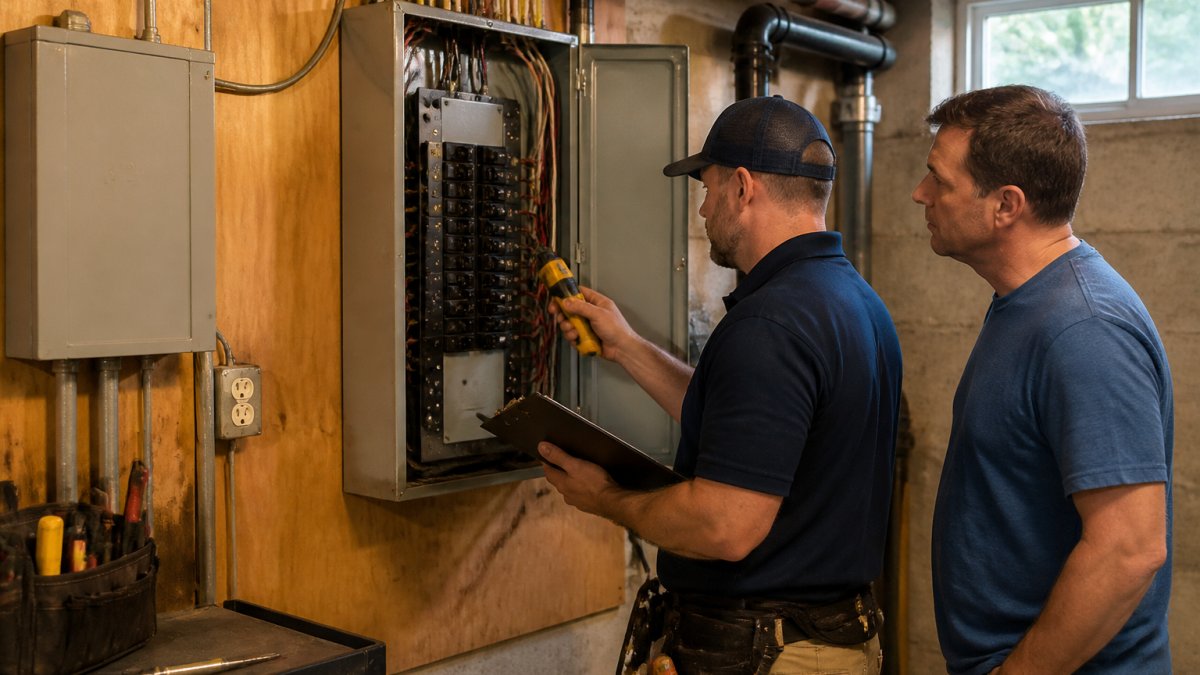
A load calculation is the math an electrician runs to determine whether your existing service can handle what you’re asking of it. It’s not based on square footage alone. It accounts for:
- The square footage of the home for general lighting and receptacles
- Fixed appliances like the range, water heater, dryer, and HVAC equipment
- Motor-driven loads and their starting requirements
- Any new load you’re adding, such as an EV charger or a standby generator
The result tells us whether your current service has headroom or whether an upgrade is the honest answer.
Panel Upgrade for an EV Charger or Standby Generator
A panel upgrade for EV charger or standby generator projects is one of the most common reasons homeowners call us. Both add significant load, and both need to be planned properly, but they stress your service in different ways, and the answer isn’t always a new panel.
EV charging: continuous load, not surge load
A Level 2 home charger is a continuous load (Alternative Fuels Data Center: Charging Electric Vehicles at Home).
Whether your existing service can absorb that depends on three things:
- Service size. A 100-amp service with an electric range, electric water heater, and central air is often already close to its limit. A 200-amp service usually has more headroom.
- Existing load. A load calculation tells us what your home actually draws, not what the panel label says.
- Charger amperage. A 48-amp charger is not the only option. A 32-amp or 40-amp charger may fit your driving needs and your service without an upgrade.
If the math is tight, an upgrade isn’t the only path. Load management devices can pause the charger when other large loads are running, and some utilities offer programs that reward off-peak charging. A qualified electrician can walk through which options fit your service and your utility’s rules.
Standby generators: sizing, transfer switches, and why a panel upgrade isn’t automatic
A standby generator doesn’t backfeed your panel through a breaker.
Generator sizing is not based on square footage. It depends on:
- Calculated electrical loads, what you actually want to run during an outage, not the whole house by default.
- Starting requirements, motors in well pumps, furnaces, and air conditioners draw a surge on startup that’s several times their running load.
- Fuel supply, natural gas, propane, or diesel, and whether the fuel line and regulator can deliver what the unit needs.
- Load management, modules that shed large loads (like an AC compressor or EV charger) while the generator runs, so a smaller generator can carry more of the house.
A panel upgrade is not automatically required for a generator installation. Many homes can support a standby generator on their existing service, especially with load management.
The right sequence is: load calculation first, equipment selection second. Picking a charger or generator before you know your service capacity leads to expensive rework, and for generators, it can mean buying a unit that’s oversized, undersized, or incompatible with your fuel supply.
If you’re considering a Generac standby generator or an EV charger, CNE Electrical generator installation and EV charger installation pages walk through what an assessment covers.
What a Panel Upgrade Involves: Permits, Inspections, and Downtime
A panel upgrade is a permitted electrical project. In most jurisdictions, that means pulling a permit, completing the work to code, and passing an inspection before the utility reconnects or the work is signed off. Here’s roughly how the process runs:
| Stage | What Happens | Typical Timing |
|---|---|---|
| Assessment | Load calculation and site review | 1 visit |
| Permit | Application filed with the local authority | Days to weeks |
| Scheduling | Utility coordination and crew booking | Varies by season |
| Install day | Panel swap, service work, reconnect | Most of a day |
| Inspection | Authority reviews and approves | Scheduled after install |
Expect your power to be off for most of install day. We tell homeowners to plan around it: charge devices, move anything perishable, and avoid scheduling work-from-home calls that day.
Panel replacement vs. service-capacity upgrade, they’re not the same thing
Homeowners often use these terms interchangeably, but they describe different scopes of work:
- Panel replacement swaps the panel enclosure and breakers, often because the existing panel is outdated, damaged, recalled, or has no open spaces. The service amperage may stay the same.
- Service-capacity upgrade increases the amperage your home can draw, commonly from 100 amps to 200 amps. This involves the meter, the service entrance conductors, the utility’s drop, and often the panel itself.
- Both together is common when an older 100-amp panel is also full or failing.
Knowing which one you actually need matters, because the scope, permitting, and utility coordination differ. A load calculation is what tells you whether you need more capacity or just a newer panel.
What affects the cost
We don’t quote panel upgrades over the phone, because the honest answer depends on your specific home. The factors that move the number most are:
- Service size change. Going from 100 to 200 amps involves more work than a like-for-like panel swap.
- Meter and service entrance condition. An older meter socket, undersized service conductors, or a mast that doesn’t meet current requirements can add scope.
- Utility coordination. Some services require the utility to disconnect and reconnect, which adds scheduling steps.
- Permit and inspection fees. These vary by municipality and are set by the local authority, not by the contractor.
- Access and routing. A panel in a finished basement, behind drywall, or in a tight closet takes more labor than one in an open utility space.
- What else is being added. If you’re also installing an EV charger, a standby generator, or a subpanel, doing the work in one visit is usually more efficient than scheduling separate projects.
The right way to get a real number is a site assessment and a written estimate based on your actual load calculation and the condition of your service.
Urgency: what can wait and what can’t
Not every sign means “call today,” but some do. Here’s how we think about it:
Call now, stop using the affected circuits:
- A burning smell near the panel or an outlet
- Buzzing, crackling, or popping sounds from the panel
- Scorch marks, melted insulation, or a warm faceplate
- Sparks or visible arcing
Schedule an assessment soon:
- A breaker that trips repeatedly and won’t stay reset
- Lights that flicker across the whole house
- A panel that’s full with no open spaces
- An outdated fuse box or a panel with known issues
Plan ahead:
- Adding an EV charger, standby generator, or major appliance
- A renovation that will add circuits
- A home purchase or insurance review that flagged the panel
If you’re seeing any of the urgent signs, don’t wait for a scheduled visit, call a licensed electrician. For everything else, a site assessment is the right next step, and we’re happy to schedule one.
Conclusion: Get a Site-Specific Assessment
Every home is different, and no article can tell you whether your specific panel needs replacing. The signs above are a starting point, not a diagnosis.
At CNE Electrical, we’re a Generac Authorized Dealer and licensed electricians serving the North Shore. We handle standby generator installation, EV charger installation, and electrical service upgrades. If you’re seeing any of these warning signs, contact us for a site assessment and a written estimate based on your actual load calculation.
Frequently Asked Questions
How do I know if my electrical panel needs to be upgraded?
Watch for breakers that trip repeatedly, lights that flicker or dim when appliances start, a burning smell or buzzing near the panel, rust or scorch marks, and panels with no open breaker spaces. Age matters too: many panels installed before the 1990s were built for far less demand than a modern home uses. A licensed electrician can inspect the panel and run a load calculation to confirm whether a panel upgrade is needed.
Do frequently tripping breakers always mean I need a panel upgrade?
No. Frequently tripping breakers can come from a single overloaded circuit, a failing breaker, or a faulty appliance rather than the panel itself. The way to tell them apart is to note which breaker trips and what was running at the time. If one circuit trips only when a specific appliance runs, that points to the appliance or circuit. If breakers trip across multiple circuits or the panel feels warm, an electrician should evaluate the whole electrical panel.
Can I upgrade my electrical panel from 100 to 200 amps?
In most cases, yes. A 100-to-200-amp service upgrade is common for homes adding an EV charger, a standby generator, or high-demand appliances. The work involves a new panel, a new service mast and meter socket as needed, a utility disconnect, and inspection by your local authority having jurisdiction. Your utility coordinates the temporary disconnect, so the process is scheduled rather than done in one visit.
Does installing an EV charger or standby generator mean I need a panel upgrade?
Not automatically. A Level 2 EV charger adds a continuous load, and a standby generator needs an automatic transfer switch and enough capacity to carry the circuits you want backed up. Whether your existing panel can support either depends on its amperage, open breaker spaces, and the results of a load calculation. Some homes need a panel upgrade; others can add the equipment with load management devices or a subpanel.
If your breakers keep tripping, your lights flicker, or your panel is simply out of room, the honest answer comes from an on-site evaluation. CNE Electrical provides licensed assessments for panel upgrades, Generac standby generator installation, and EV charger installation across the North Shore. Get started with CNE Electrical and get a clear, no-guesswork plan for your home’s electrical capacity.